Journey Into Mystery 123
Our Story
 The Mighty Thor has agreed to take the reporter Harris Hobbs to see Asgard. The Absorbing Man has ignobly attacked Odin, with Loki planning to take over rule of the golden realm after his cats paw has done his work for him. And that’s just the beginning! Arriving on the rainbow bridge with Hobbs, Thor sees that Heimdall is absent from his post as guardian. Knowing something is amiss, he hurries with Hobbs into the city to find the battle raging between the Absorbing Man and Odin. The All-Father slowly realizes that cosmic bolts and molecular cyclones are as easy for Crusher Creel to absorb as rock or metal. On Earth, another type of storm brews, as the lost Norn Stone is found in an Asian jungle by the witch doctor of a tribe threatened with Communist takeover. The stone having fallen from the sky, it is seen by the witch doctor as a sign from the gods that he is meant not only to turn back the communists, but to rule the world as well. Thor (with Hobbs holding himself together enough to take it all in), eager to join in the fray, is asked by Odin to hold his hammer for a moment. Seeing that any further battle will destroy his kingdom, Odin surrenders his scepter to “Loki the cunning”, who glows with greed, proclaiming the rule of a new age. The Absorbing Man feels the scepter should be his, and a mighty tug-of-war begins. All this has played out, as Odin knew it would; the two evildoers can’t let go of the scepter. Odin, his real power coming from within, hurls the pair, eternally bound to each other, to fly through endless space for an indefinite time. Thor returns to Earth with Harris Hobbs, whose memory even now fades; he questions if Thor even took him to Asgard. The witch doctor meanwhile, has adopted the name the Demon from some of the villagers he has sworn to his side, as he builds his army to conquer the world.
In the Tales Of Asgard, the approach of Ragnarok, the end of the world, seems imminent, as Odin watches dark writhing clouds from atop the highest mountain in Asgard. The crew of the Odinship, led by Thor, enters “The Jaws Of the Dragon”. As it’s rock head rises from the stormy sea, it is the efforts of Balder the Brave that save them, when he blows so hard on his mighty horn that the dragon is shattered into countless pieces.
JB: Nicely interwoven story here, hard to believe that the Absorbing Man has been with us for four issues. We get a clear picture of Odin’s real power source—himself, as he must finally see Loki for the villain he really is.
 The Mighty Thor has agreed to take the reporter Harris Hobbs to see Asgard. The Absorbing Man has ignobly attacked Odin, with Loki planning to take over rule of the golden realm after his cats paw has done his work for him. And that’s just the beginning! Arriving on the rainbow bridge with Hobbs, Thor sees that Heimdall is absent from his post as guardian. Knowing something is amiss, he hurries with Hobbs into the city to find the battle raging between the Absorbing Man and Odin. The All-Father slowly realizes that cosmic bolts and molecular cyclones are as easy for Crusher Creel to absorb as rock or metal. On Earth, another type of storm brews, as the lost Norn Stone is found in an Asian jungle by the witch doctor of a tribe threatened with Communist takeover. The stone having fallen from the sky, it is seen by the witch doctor as a sign from the gods that he is meant not only to turn back the communists, but to rule the world as well. Thor (with Hobbs holding himself together enough to take it all in), eager to join in the fray, is asked by Odin to hold his hammer for a moment. Seeing that any further battle will destroy his kingdom, Odin surrenders his scepter to “Loki the cunning”, who glows with greed, proclaiming the rule of a new age. The Absorbing Man feels the scepter should be his, and a mighty tug-of-war begins. All this has played out, as Odin knew it would; the two evildoers can’t let go of the scepter. Odin, his real power coming from within, hurls the pair, eternally bound to each other, to fly through endless space for an indefinite time. Thor returns to Earth with Harris Hobbs, whose memory even now fades; he questions if Thor even took him to Asgard. The witch doctor meanwhile, has adopted the name the Demon from some of the villagers he has sworn to his side, as he builds his army to conquer the world.
 In the Tales Of Asgard, the approach of Ragnarok, the end of the world, seems imminent, as Odin watches dark writhing clouds from atop the highest mountain in Asgard. The crew of the Odinship, led by Thor, enters “The Jaws Of the Dragon”. As it’s rock head rises from the stormy sea, it is the efforts of Balder the Brave that save them, when he blows so hard on his mighty horn that the dragon is shattered into countless pieces.
JB: Nicely interwoven story here, hard to believe that the Absorbing Man has been with us for four issues. We get a clear picture of Odin’s real power source—himself, as he must finally see Loki for the villain he really is.
PE: Yep, a satisfying conclusion to The Absorbing Man storyline. Without peeking, I wonder just how long Stan can keep Loki exiled in space. It only took him a few issues to find Doctor Doom a way back. My money's on a short flight. One thing's for sure: Odin has got to have his eyes wide open by this time. Calling his son "god of evil" is just not said around the dinner table of a functioning family. The new sub-plot involving the witch-doctor turned Demon looks interesting. This strip is still flying just above-average for me.


JB: The Demon is an interesting character visually; mainly he ties us over as we approach the longest continued storyline that Lee/Kirby would do in the Thor run. Speaking of visuals, the cover is a sort of symbolic one. I love the panel of Thor and Harris Hobbs when they first arrive on Bifrost. I wonder just how far the distance to Asgard is from there, as Thor tells the reporter to walk with “slow and measured tread.”
MB: Although Stan leaves a few newer plot threads dangling with that cockamamie Norn-stone-enhanced witch doctor (aka The Demon), he ties up many more with Loki’s rebellion and Hobbs’s attempt to blackmail Thor. It’s fitting that Loki and his creation, the Absorbing Man, are banished together—although not permanently, I’m sure—as we learn the not-so-shocking news that Odin is far mightier than both of them. And Thor is lucky that he got only a mild reprimand for bringing Hobbs to Asgard; even after helping to save his dad’s bacon, I could see Thor getting one of those “Begone, churl! Thou dost presume too much!” speeches.

JB: If nothing else, the Tales Of Asgard segments flesh out the great supporting characters surrounding Thor, this time highlighting Balder (the one significant missing Asgardian in the Thor movie).
MB: Although Stan leaves a few newer plot threads dangling with that cockamamie Norn-stone-enhanced witch doctor (aka The Demon), he ties up many more with Loki’s rebellion and Hobbs’s attempt to blackmail Thor. It’s fitting that Loki and his creation, the Absorbing Man, are banished together—although not permanently, I’m sure—as we learn the not-so-shocking news that Odin is far mightier than both of them. And Thor is lucky that he got only a mild reprimand for bringing Hobbs to Asgard; even after helping to save his dad’s bacon, I could see Thor getting one of those “Begone, churl! Thou dost presume too much!” speeches.

JB: If nothing else, the Tales Of Asgard segments flesh out the great supporting characters surrounding Thor, this time highlighting Balder (the one significant missing Asgardian in the Thor movie).
Fantastic Four 45
Our Story
Our Story
 As the building beneath them shatters (from the mighty foot stomp of Gorgon last issue), Johnny, Ben and Reed use their powers to save themselves from the fall. Johnny takes flight to find out where Dragon Man has gone when he took flight with Sue moments before. He catches them quickly enough, and creates a blinding light to temporarily blind Dragon Man, grounding him. Reed rushes to get his airjet-cycle ready to go in pursuit, but Sue, Johnny and Dragon Man return peacefully. Sue’s convinced the laboratory created creature that they mean him no harm. Leaving the others to figure out what to do next, Torch decides to take a walk when he calls Dorrie Evans to find she has another date. He wanders into a run-down neighborhood, and finds a vision to burn any thoughts of Dorrie out of his head: a lovely young girl with orange hair. She panics when he sees her, and a momentary storm appears, apparently created by her, and she disappears. The next day, Johnny isn’t much help to the team as they clean up shop at the Baxter Building, so he cuts out for a walk to guess where-- the sight of the beautiful sight from yesterday. Sure enough, he finds the girl again. She flees, but when she sees Johnny flame on, she relaxes, introducing herself as Crystal, and calling him “one of us.” He plays along to find out more about her, and she leads him (along with her mysterious, giant “dog” named Lockjaw, who appears out of nowhere) through a secret entrance into her world. She reveals that an absent leader named Blackbolt built their home for her kind. Johnny meets some of the others. First up is Karnak, able to find the weakest spot in any object and shatter it with a karate-style chop. Another is Triton, a green-skinned partly cloaked figure who seems to control powers of water. Next to appear are none other than Madame Medusa and Gorgon. As the Torch tries to piece together the mystery of this race he later coins “Inhumans”, Triton tries to capture him with fireproof walls that spring up out of nowhere, forming a cage that fills with water. The ceiling isn’t fireproof though, and Johnny burns his way to the surface to form the emergency “4” flare in the sky. Despite the delay of a scuffle between Dragon Man (solved by a tranquilizer shot) and the Thing, Reed’s latest gizmo, the airjet-cycle is ready to go, and they head to the scene of Johnny’s signal. As the Torch leads them to the scene of the entrance, a wall of rubble, courtesy of Karnak and Gorgon, tumbles down on them. Ben shatters it in time, as a heretofore-unseen Inhuman appears, smashing through a wall: Blackbolt!
JB: Despite the conceptual similarity between the Inhumans and the X-Men, these new characters, not really villains, can hold their own identities as worthy opponents. I always preferred these guys. It’s a nice entrance for Crystal, Johnny’s soon-to-be girlfriend of long standing. Dragon Man and the brief appearance of Sandman and the Trapster in jail, keep this issue a busy one.

JS: It's been quite a long time since I read this issue, but I had forgotten we only get the tease of Black Bolt this issue. Fortunately, good times are on the horizon!
JB: Is there no end to Reed’s inventions? What a blast to ride in that airjet-cycle! It makes a great full pager, but it’s the cover that is the masterpiece of this issue; a mix of beauty and mystery.

PE: So, it's Johnny Storm who coins the phrase "Inhumans." That must have gone over well with his "inhuman" girlfriend, Crystal.
Daredevil 11
Our Story
 Daredevil is caught eavesdropping on the villains at their headquarters by Bird Man. A brief fight ensues, ending with Daredevil’s seeming demise. The hero is okay, though, and he starts to put a plan in motion to find out the secret identity of the Organizer. He has it narrowed down to three prominent politicians in the Reform Party. As Matt Murdoch, he asks a skeptical Foggy for his help, and Foggy reluctantly complies, thinking that Matt is just jealous of him. In front of the three suspects at a gathering, Matt and Foggy bluff out loud that they have evidence in their office that reveals who the Organizer is. Sure enough, later that night, their law office is broken into. Daredevil uncovers a plot to kill the mayor when he overhears Deborah, Foggy’s old school crush and undercover villain, talking to the Organizer through one of his monitors. She agrees to work with Double D and the authorities since she didn’t want to go along with the murder plot and was marked for death by the Organizer. Deborah lures Frog Man into a trap and he is beaten by Daredevil. Daredevil switches costumes with him and goes on to meet the Organizer with Bird Man and Ape Man. Daredevil attacks them in his frog disguise, while secretly recording the rambling villain’s plans for city conquest. It’s broadcasted all over the television and radio waves so the police have the evidence. Daredevil retreats to recoup, donning his usual hero attire. Abner Jonas, the party candidate for Mayor, turns out to be the nefarious Organizer. He tries to set up another candidate with no luck. In the end, Daredevil defeats Ape Man and Bird Man, bringing the Organizer to justice. All is not rosy for our hero, as he leaves the law firm because of the poor business they have been having, rationalizing that Foggy by himself with Karen will be able to prosper more without him.
 |
| Now that's a Wally Wood panel! |
Jack: First, the good news: Daredevil is now monthly! Now, the bad news: This is Wally Wood’s last issue. Even though he was only inking “Bobby” Powell’s pencils, the trademark Wood greatness made itself evident. Witness the va va voom shot of Debbie on page seven if you doubt Wood’s ability to impose his will on a penciller. As to the story, Stan’s wrap-up of Wood’s plot from last issue is standard fare, ending with a much too heaping helping of sappy romance. Next month, the Daredevil artist merry go round continues as John Romita takes over!
PE: If you were Wally Wood and you had to put up with Stan Lee's ego, you head for the door before too long as well. Stan explains in his intro the issue that he allowed Wally to script the first part "just for a lark... but now it's up to sly ol' Stan to put all the pieces together and make it come out okay in the end." Obviously, this guy could be a genius but he could be an ass as well.
 Tom: I’m sure my fellow professors will probably disagree with me on this one, but this finale kind of sucked. Too much going on with secret villains, goofs dressed as animals, corrupt politicians, and the love triangle is getting depressing along with being boring. Last issue I kind of liked, but this conclusion started to drag. According to the bullpen, Stan the man took over writing duties. Could this have had something to do with it? The Organizer guy and his whole shtick grew tiresome, making me long for Mr. Fear to come back.
PE: This professor won't disagree, Professor Tom. This is one big stinky mess. First we get Matt Murdock, standing in a room with Foggy, thinking that two of the three candidates have "unusually fast" pulse rates. Then three panels later, as he and Happy Hogan Foggy Nelson are walking Karen Page back to the office, he thinks to himself, "Karen's heartbeat is unusually rapid. If only I could tell whether it's Foggy or me who is responsible." Why didn't he think the same of the three candidates? Maybe the politicians thought one of the partners was hot. And, while we're on the subject of super-sense, why is it that, with all his heightened senses, DD can't figure out who The Organizer is just by listening to his voice? Stan throws in a really lame explanation that Daredevil can somehow sense that the ring on the bad guy's finger is the same as the one on Jonas'. Heightened senses, my foot. And what kind of a dope is The Organizer if he can't tell someone else is in the Frog Man's suit?
Jack: The pages used to reproduce this story for the Essentials volume must have been in bad shape, because the art looks terrible, even for the Grade Z team of Bob Powell and Mickey Demeo. Though it was supposedly “designed” by Jack Kirby, I’m hard pressed to see evidence of it. I found this story boring until the last page, where it suddenly gets interesting. The Leader is dead? Not so fast.
PE: Kang says his century fears him but that's a hollow triumph when coupled with the major defeats he's suffered at the hands of The Avengers. He then decides that taking them on now that they lack any super power whatsoever would be great fun. Talk about a hollow victory! And none of the remaining Avengers (Scarlet Witch, Hawkeye, Quicksilver) were even involved in the past quarrels, so how is that revenge? He is brilliant though, flying into town in a UFO that resembles the top of Avengers Mansion. The "Mighty" Avengers walk right into his trap, then look at each other quizzically and ask each other if there really was a 12th floor to Avengers Mansion. Heck's art gets completely lost in John Romita's inks. That's a good thing. The pleasure of "Jazzy" Johnny's presence will be felt only for only this issue, unfortunately, before we're subjected to the underwhelming duo of Heck and Ayers on art chores. As Ronnie Van Zant once elegantly put it: "Somebody show me the back door."

MB: Stan really puts the new Avengers to the test, pitting Cap’s Kooky Quartet Minus Cap against one of the Assemblers’ toughest foes, Kang. I’ve always found his relationship with Princess Ravonna interesting because, as her father points out, he really does love her, in his own weird way, and even she admits she might reciprocate if he weren’t such a, well, conqueror. We get an early Silver Age credit for legend-in-waiting John Romita, whose inking—like Wood’s—complements but does not overshadow Heck’s pencils (oddly, those training-camp scenes almost smacked, if you’ll pardon the pun, of Frank Robbins), while Stan’s obviously having a whale of a time writing Kang’s dialogue: “Silence! Your punishment will be swift and severe! Now go!”
PE: On the letters page, Stan admits that the "Marvel Pop Art Productions" logo that ran on the covers of all the Marvel Comics from August through November 1965 was a mistake. Ostensibly, it was used to try to draw in older fans looking for advanced reading fare.
Strange Tales 139
Nick Fury, Agent of SHIELD
Our Story
 Hydra’s “most potent hypnotic devices” are unable to wrest the secret of the Braino-saur from Fury’s subconscious, so their leader plans to wait and execute him after the world has surrendered. Stark reveals the Braino-saur’s purpose—to disarm the betatron bomb in orbit—and supervises its blast-off, while Jones and Dugan spearhead a last-ditch effort to locate and rescue Fury. Analyzing the guidance system of the captured Hydra-Ram reveals its point of origin, and the boys fire it up to look for Fury, who uses both his explosive shirt and an offer of assistance from the Hydra leader’s right-thinking daughter, Agent G, to escape his cell, so they shoot it out with human goons and battle the mechanical Hunter as S.H.I.E.L.D. arrives.


Jack: After getting used to John Severin, we get Kirby and Sinnott, which is not a bad trade off. I would like to know more about energy compression and its uses in food service. What was with the Hydra agent in the last panel holding a red, white and blue shield that read “Priority A-1”? Or was it floating in front of him?
Doctor Strange
Our Story
It’s a tag-team throwdown between Dr. Strange and Mordo, with the Ancient One out of his coma and able to give a wee power boost along with advice to the good doctor. Mordo’s power is supplemented by that of Dormammu, as Clea watches helplessly by the Dreaded One’s side. Dr. Strange uses his wits to make the Baron look bad, but as the story ends it looks like Dormammu has had enough of sitting on the sidelines.
Jack: This was an unusually exciting episode, even though it is basically just Dr. Strange and Mordo casting spells at each other. When will we learn Clea’s name? Ditko’s pencils and inks are very strong, producing some of his best art.
MB: As with the concurrent issue of Spider-Man, this story’s plot is no longer attributed to Ditko; he and Stan are simply credited with “art” and “script,” as they will be next month, but after that, things start to get interesting. Regardless of its pedigree, this excellent episode ratchets up the tension even further and, like the cinematic serials that form its structural model, begins with an exact rerun of the prior chapter’s ending. We haven’t seen this much interplay between Strange and the (conscious) Ancient One for a long time, and although the arc has yet to reach its climax with next issue’s Doc/Dormammu rematch, we can already see how the wisdom Eternity spoke of enables Strange to outfight Mordo in spite of his extra power.
JS: While I'm looking forward to the Dormammu showdown, I have to admit I'm a little disappointed that Mordo isn't living up to the arch-enemy I thought he would be when he was introduced.


 PE: I like the first part of this arc well enough. There's the mystery of the sleepers and the enormity of the first weapon when it's woken, the anticipation of an appearance by The Red Skull (you know it's going to happen eventually), and the ease in which Stan slides back and forth between the 1940s and 60s. I just can't stand this art. Tuska's Nazi burgomeister could have stepped out of a Mad parody and the Sleeper (which should be awe-inspiring) resembles a coffee pot with boots. We should be happy it doesn't have trunks, right? What Kirby could have done with this strip! Art aside though, I'm still looking forward to future installments.
The X-Men 15
Our Story
 Iceman and The Beast are captured by The Sentinels and taken into their underground fortress. There The Beast is bombarded with a Mental Psycho-Probe and forced to relate how he became The Beast and an X-Man. His partners manage to release Iceman from a glass prison but, on the way to rescue Hank, are rendered immobile by The Sentinels. The head Sentinel, Master Mold, delivers an ultimatum to his creator, Bolivar Trask: create enough Sentinels to rule Earth or die.
PE: A good enough second chapter to this story line but The Sentinels still look like little play robots to me, no sense of danger at all. We get a few more high-falutin' gizmos: The weapons mounted inside the Sentinels' bunker are labeled "Nature Activator Rays" by Xavier. Later, Hank McCoy falls victim to the Mental Psycho-Probe. I always wonder if Stan ever did any homework with these contraptions or if he'd just throw two cool-sounding words together and fly by the seat of his pants.
JS: Once again, I'm able to appreciate the Sentinels knowing how they will be used in the years ahead. Sure, they're probably the most impractical means of dealing with Mutants (and not very effective at this stage in their development), but there's something about them that remains interesting. I'll be curious to see if the next generation of Sentinels will be described as being of the Master Mold size.
MB: Now monthly for the first time, as Daredevil will be starting with his next issue, our merry mutants take the battle inside Master Mold’s fortress in the second segment of the original Sentinels trilogy. I’ve now learned that penciler “Jay Gavin” was a pseudonym for Werner Roth; this time out, the King and Dick Ayers are the Moe and Curly to his Larry, and—to give a single example—the anguished shot of Trask in page 7, panel 4 looks like he wandered in from a totally different mag. Just as we learned about Xavier’s hateful upbringing with Cain Marko while the Juggernaut battered at the gates, this battle is intercut with the biography of the bouncing Beast.
PE: And a lazy origin it is, Professor Matthew. There's nothing that smacks or originality to it. It's cut and pasted from other heroes. Exposed to radiation. Picked on as a kid. Misunderstood. Interchangeable with a half dozen other super guys.
JS: It did come across as a 'filler' origin story. But I was never a big Beast fan until he got the blue fur...

The Amazing Spider-Man 31
Our Story
 Spider-Man busts up a robbery by the henchmen of The Master Planner (a villain who's crossed paths with the web-slinger under a different guise) but the bad guys still manage to cart off the expensive scientific equipment to their undersea lair. Meanwhile, Peter Parker has his first day at ESU, a whirlwind of activity that nearly succeeds in knocking the teen flat. That finally occurs when he gets home and his Aunt May collapses and must be taken to the hospital in an ambulance. Distraught, the teen spends his days sleepwalking through his classes and seeking out crime at night in order to pay bills with his photography. Parker is so muddle-headed at school that he doesn't notice the new students around him, including future girlfriend Gwen Stacy and future best friend Harry Osborn. Believing Peter to be egotistical (rather than sleepy) the fellow classmates chirp about his bad manners. When Spidey breaks up another robbery of equipment, The Master Planner vows it will be the last time Webhead meddles in a bad guy's business.
 PE: Gosh, it's confusing keeping all the Master Planner verbiage straight this issue. Why, in one sequence, Plan "G" is carried out and Task Force "R" is sent to recover the spoils of said plan. It's no wonder these henchmen bumble as much as the superheroes. Can you just imagine all these teams on the battlefield. Captain America yells out "All right, Hawkeye, execute Plan "G" now!" and both sides execute their own Plan "G" at the same time? It could get ugly! What's even more confusing is that Professor X has Iceman execute a "Plan G" in this month's X-Men. I wonder if Marvel superheroes have some kind of protocol for this if they're working together on a case. "Now, look," says Professor X, "under no circumstances are we to execute Plan Z while we're helping out Iron Man. I've studied his paperwork and his Plan Z is the opposite of ours."
JS: Do you think Stan was being lazy, or was he cribbing the alphabet soup planning from some other source?
 PE: I'm not sure how this story went over with 1965 readers -- too much talking heads, not enough action? -- but to this Marvel maniac, one who knows what happens years in the future to the newly introduced Gwen Stacy and Harry Osborn, this is pure eye candy. In one issue we're introduced to the girl who finally won Peter Parker's heart (for the first time) and then took a tragic header off a bridge and the man who would become Peter's dearest friend, a junkie, a schizophrenic and, finally, the apple that didn't fall far from the tree. Ditko's version of Gwen hypes the bombshell aspect whereas, with time and other artists, we come to know her as a "nice girl." I remember being an eleven year old kid when "that event" happened in The Amazing Spider-Man #121 and actually shedding a few tears. Nothing that I'd read in a comic book had ever had such an effect on me and nothing has since. If pushed, I'd offer that run of #121 through #149 as my Golden Age of Spider-Man (yep, Spider-Clone included!). Now, what were we discussing?

MB: This is certainly a “major life changes” issue for Peter, featuring not only the oft-ailing Aunt May’s biggest health challenge to date, but also the start of his career at ESU and the debuts of Harry Osborn [insert Dragnet sting], Gwen Stacy, and Professor Warren. It bespeaks Stan’s maturing scripting, and Spidey’s impressive array of characters and subplots, that we’re quite happy to have the business with the Master Planner—whose identity I believe I remembered while reading this story—take a decided back seat. For the girl who became Peter’s tragic love interest, Gwendy seems awfully shallow here, yet what’s really disorienting is to see her and Harry, so firmly associated with John Romita, rendered by Ditko, who is now no longer credited as plotter [Dragnet sting optional] and reverts to the panel-heavy format to cram it all in.
JS: Unfortunately knowing that Aunt May still has quite a few decades left in her makes her 'episodes' far less dramatic.
PE: A fabulous issue, one of the best Spideys thus far. I'm not quite sure why The Master Planner wants his real identity hidden from the world he's about to conquer but I'll chalk it up to a good mystery. This is one of those issues that makes you want to skip ahead and read the next one right now!
JS: Despite her occasionally exhibiting the early warning signs of Ditko-head, Gwen Stacy is a unique looking babe in the Marvel Universe. Now, how much longer before we get normal looking characters in Spider-Man?
1965 Year-End Review
At the end of 1964, Marvel was publishing seven monthly superhero comics, two bi-monthly superhero comics, a monthly war comic, three bi-monthly westerns, and four humor comics, two of which were monthly. From a distribution standpoint, things did not change very much in 1965. By the end of the year, the two bi-monthly superhero comics had just gone monthly (Daredevil and X-Men), and one of the bi-monthly humor comics was about to end its run (Patsy Walker).
More important to us, though, were the changes in the contents of the superhero books. New artists like Wally Wood and John Severin were changing what the comics looked like—no longer was Marvel a three-person company made up of Lee, Kirby and Ditko, with occasional contributions by other creators. This trend would pick up steam in 1966, as Stan Lee’s (alleged) attempt to write all of the comics singlehandedly would slow down.
As for the contents, new heroes and villains were introduced, many of whom would last a long time in the Marvel Universe: Ka-Zar, Medusa, the Absorbing Man, Hawkeye, the Black Widow, the Juggernaut, and Hercules were all either introduced or featured more prominently in this year’s issues. Reed Richards and Sue Storm tied the knot, and the Sleepers awoke.
And the MU professors are eternally grateful for two events that occurred in comics with an August 1965 cover date: Sub-Mariner replaced Giant-Man in Tales to Astonish, and Nick Fury replaced the Human Torch in Strange Tales. Those two series changes alone led to a significant improvement in the content of the monthly books (and a more than significant improvement in our mental health-Prof. P).
By the end of 1965, the Merry Marvel Marching Society was in full swing, Marvel merchandise was being sold in house ads, the Bullpen Bulletins were beginning to take shape, and the Marvel revolution was about to begin. In 1966, things would explode, as a TV series would bring Marvel characters into millions of homes.
Also this month
Marvel Collectors' Item Classics #1
Millie the Model #133
Modeling with Millie #44
Patsy and Hedy #103
Patsy Walker #124 (final issue)
Rawhide Kid #49
Sgt Fury and His Howling Commandos #25
SOME HIGHLIGHTS
 Marvel Collectors' Item Classics was created for much the same reason as Marvel Tales: to make money off comics that had already been published. Not that that was a bad thing since the collectors' market at the time was microcosmic and finding those elusive first few issues of your favorite Marvel title was nigh impossible. Back then, not many readers cared about 9.2 grading and mylar bags so reprints in a big jumbo package was the proverbial "present under the Christmas tree." The first issue reprints (in their entirety, says Stan "The Man"): Fantastic Four #2, The Ant-Man story from Tales to Astonish #36, Tales of Asgard from Journey Into Mystery #97, and The Amazing Spider-Man #3. The title would continue to reprint, chronologically, Fantastic Four and a variety of other strips (with a retitling of Marvel's Greatest Comics with its 23rd issue) until it was reduced in size with #34 when it focused exclusively on FF reprints. It lasted 96 issues.

PE: If you were Wally Wood and you had to put up with Stan Lee's ego, you head for the door before too long as well. Stan explains in his intro the issue that he allowed Wally to script the first part "just for a lark... but now it's up to sly ol' Stan to put all the pieces together and make it come out okay in the end." Obviously, this guy could be a genius but he could be an ass as well.

 |
| Gosh! Could that ring be a clue? |
Jack: Apparently, in Marvel Comics New York City, “Agent of Shield” is a TV show!
PE: How long before Stan explains that Daredevil, with his heightened senses, can actually read the thought balloons in the room? That last page is awash in dopiness.
PE: How long before Stan explains that Daredevil, with his heightened senses, can actually read the thought balloons in the room? That last page is awash in dopiness.
Tales to Astonish 74
The Sub-Mariner
Our Story
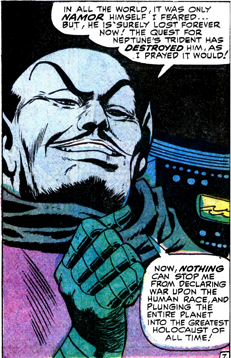
 As Dorma is encased in a plastic cage, Sub-Mariner battles for their lives against the hordes of Faceless Ones. While individually no match for Prince Namor, they try to overwhelm him with their seemingly endless numbers. Krang has been having troubles of his own with the citizens’ uprising. He’s got it under control, though, when he unleashes his Robo-Tank! It’s basically a big underwater tank piloted by a little robot guy that shoots down the citizens with electric bolts. Krang boasts to himself that once they regain consciousness, the rabble rousers will no longer have the determination to overthrow his regime. The ancient old dude that Namor met a couple of issues ago is trying to find him. Using his telepathic mind, he tracks him down to the Faceless Ones’ lair. The story ends with Dorma being held in Subby’s arms, while he promises the Faceless mob that they may win, but it will cost them dearly as he prepares for final battle.
Tom: So far so good, as Subby’s series continues to swim toward excellence. First chink in the armor though may be Krang’s moronic looking Robo-Tank weapon. It looked like it was being piloted by a distant cousin of that robot that was in the old Fantastic Four cartoons. Krang is starting to grow on me as villain. Before, all I remember him for was getting his ass handed to him by Dr. Doom in a sword fight in Marvel SVTU. He’s kind of like an underwater Fu-Manchu.
 MB: Not so very long after Namor was barking at Lady Dorma to “unhand” him, he puts her well-being above his quest for the trident that could help him regain his throne, although I somehow suspect that this will turn out to be the final test. These Faceless Ones don’t appear to be as interesting as the Mindless Ones over in Strange Tales, and yet surely we don’t want to leave Dorma at their mercy in her giant Ziploc® bag; as in Night of the Living Dead et alia, their greatest strength lies in their numbers. The citizens of Atlantis, fickle though they may be, prove they are not beyond redemption by risking their lives to rebel against Krang.
PE: That hometown rebellion was the highlight of the issue for me (well, other than the usual wonderful Colan artwork). I thought it was more subtly handled than the usual Stan Lee action scene. For reasons that will become apparent as you read through this month's comics, I love that Krang orders his Robo-Tank to "perform function 'G'. This month, Marvel Comics was brought to you by the letter 'G'.
Hulk
The Sub-Mariner
Our Story
 As Dorma is encased in a plastic cage, Sub-Mariner battles for their lives against the hordes of Faceless Ones. While individually no match for Prince Namor, they try to overwhelm him with their seemingly endless numbers. Krang has been having troubles of his own with the citizens’ uprising. He’s got it under control, though, when he unleashes his Robo-Tank! It’s basically a big underwater tank piloted by a little robot guy that shoots down the citizens with electric bolts. Krang boasts to himself that once they regain consciousness, the rabble rousers will no longer have the determination to overthrow his regime. The ancient old dude that Namor met a couple of issues ago is trying to find him. Using his telepathic mind, he tracks him down to the Faceless Ones’ lair. The story ends with Dorma being held in Subby’s arms, while he promises the Faceless mob that they may win, but it will cost them dearly as he prepares for final battle.
 Tom: So far so good, as Subby’s series continues to swim toward excellence. First chink in the armor though may be Krang’s moronic looking Robo-Tank weapon. It looked like it was being piloted by a distant cousin of that robot that was in the old Fantastic Four cartoons. Krang is starting to grow on me as villain. Before, all I remember him for was getting his ass handed to him by Dr. Doom in a sword fight in Marvel SVTU. He’s kind of like an underwater Fu-Manchu.
PE: That hometown rebellion was the highlight of the issue for me (well, other than the usual wonderful Colan artwork). I thought it was more subtly handled than the usual Stan Lee action scene. For reasons that will become apparent as you read through this month's comics, I love that Krang orders his Robo-Tank to "perform function 'G'. This month, Marvel Comics was brought to you by the letter 'G'.
Hulk
Our Story
The Hulk has been sent to the Watcher’s dwelling by the Leader to claim the Ultimate Machine. However, another powerful alien brute has been sent by his home planet to obtain the same prize. The Hulk does battle with a big, red, amphibious monster that causes the Watcher to transport them to an abandoned planet to finish their extreme combat. Even though he is not permitted to interfere, the Watcher justifies his move by rationalizing that the two monsters could do too much damage to his scientific equipment, and put his own life in danger. The battle goes back and forth, on land and in the sea. Finally, the Hulk wins when he rips up the stone ground from underneath his opponent, and hurls him with all his might into the air. The Watcher has seen enough to declare ol’ Greenskin the winner, since the red beast would have been soaring in the air for days before landing. He transports the loser red monster back to his home planet and the Hulk gets to take the Ultimate machine back to Earth. Once he is back inside the Leader’s hangout, the Leader snatches the golden orb away from him and lets it form around his big head. At first the Leader is deliriously happy as he can feel the Ultimate Machine fill him with enough power to make all of mankind his slaves. His happiness is cut short as he soon begins to realize that something is wrong. He panics briefly, before seemingly dying as the Hulk looks on in bewilderment.
The Hulk has been sent to the Watcher’s dwelling by the Leader to claim the Ultimate Machine. However, another powerful alien brute has been sent by his home planet to obtain the same prize. The Hulk does battle with a big, red, amphibious monster that causes the Watcher to transport them to an abandoned planet to finish their extreme combat. Even though he is not permitted to interfere, the Watcher justifies his move by rationalizing that the two monsters could do too much damage to his scientific equipment, and put his own life in danger. The battle goes back and forth, on land and in the sea. Finally, the Hulk wins when he rips up the stone ground from underneath his opponent, and hurls him with all his might into the air. The Watcher has seen enough to declare ol’ Greenskin the winner, since the red beast would have been soaring in the air for days before landing. He transports the loser red monster back to his home planet and the Hulk gets to take the Ultimate machine back to Earth. Once he is back inside the Leader’s hangout, the Leader snatches the golden orb away from him and lets it form around his big head. At first the Leader is deliriously happy as he can feel the Ultimate Machine fill him with enough power to make all of mankind his slaves. His happiness is cut short as he soon begins to realize that something is wrong. He panics briefly, before seemingly dying as the Hulk looks on in bewilderment.
 |
| Bad art or bowel movement? |
Tom: Great Marvel fisticuffs action. This story seems to be the precursor to when the Hulk series started turning into a regular smackdown each issue, with Jade Jaws always going up against some villainous opponent who would try to knock his block off. The big, red, fish critter that got defeated in this story is sort of a lost classic villain of the Hulk. He would come back again every once in awhile to engage the Hulk in further tests of fighting, but he never received the popularity of other Hulk antagonists like the Abomination, Rhino, Leader, or Absorbing Man.
Jack: I would mention that this story reminds me of Fredric Brown’s “Arena” and the Outer Limits episode “Fun and Games,” but that would just get me in more trouble.
PE: Don't worry Jack, Schow doesn't read this blog.
Avengers 23
Our Story
 Having quit the Avengers, Steve Rogers takes a job as a sparring partner for a champion boxer, though he races back to Avengers mansion as soon as he hears that the Avengers have disappeared. They have been kidnapped by Kang the Conqueror and brought to his future world, where he wants to display his prowess so that Princess Ravonna will agree to marry him. The Avengers fight hard and are soon joined by Captain America, whose challenge to Kang led to his also being brought to the future. The battle is not going well and, when Ravonna spurns Kang’s advances, he sets his army toward destroying her kingdom, with only the Avengers poised to stop him.
Jack: Kang was always one of my favorite Marvel villains, and his appearance, which had varied from story to story up to this point, is really beginning to take shape under the guiding artistic hands of Don Heck and John Romita. Romita’s inks really dominate Heck’s pencils (as did Wally Wood’s last issue), making this a feast for the eyes, at least for this long-time Romita fan. It also seems like Captain America is starting to look the way I remember him looking from the early 70s. Last of all, I want to praise Kirby’s terrific cover!
 |
| Don't you mean BARRROOOOOM!? |
Jack: I would mention that this story reminds me of Fredric Brown’s “Arena” and the Outer Limits episode “Fun and Games,” but that would just get me in more trouble.
PE: Don't worry Jack, Schow doesn't read this blog.
Avengers 23
Our Story
 Having quit the Avengers, Steve Rogers takes a job as a sparring partner for a champion boxer, though he races back to Avengers mansion as soon as he hears that the Avengers have disappeared. They have been kidnapped by Kang the Conqueror and brought to his future world, where he wants to display his prowess so that Princess Ravonna will agree to marry him. The Avengers fight hard and are soon joined by Captain America, whose challenge to Kang led to his also being brought to the future. The battle is not going well and, when Ravonna spurns Kang’s advances, he sets his army toward destroying her kingdom, with only the Avengers poised to stop him.
 Jack: Kang was always one of my favorite Marvel villains, and his appearance, which had varied from story to story up to this point, is really beginning to take shape under the guiding artistic hands of Don Heck and John Romita. Romita’s inks really dominate Heck’s pencils (as did Wally Wood’s last issue), making this a feast for the eyes, at least for this long-time Romita fan. It also seems like Captain America is starting to look the way I remember him looking from the early 70s. Last of all, I want to praise Kirby’s terrific cover!
PE: Kang says his century fears him but that's a hollow triumph when coupled with the major defeats he's suffered at the hands of The Avengers. He then decides that taking them on now that they lack any super power whatsoever would be great fun. Talk about a hollow victory! And none of the remaining Avengers (Scarlet Witch, Hawkeye, Quicksilver) were even involved in the past quarrels, so how is that revenge? He is brilliant though, flying into town in a UFO that resembles the top of Avengers Mansion. The "Mighty" Avengers walk right into his trap, then look at each other quizzically and ask each other if there really was a 12th floor to Avengers Mansion. Heck's art gets completely lost in John Romita's inks. That's a good thing. The pleasure of "Jazzy" Johnny's presence will be felt only for only this issue, unfortunately, before we're subjected to the underwhelming duo of Heck and Ayers on art chores. As Ronnie Van Zant once elegantly put it: "Somebody show me the back door."

MB: Stan really puts the new Avengers to the test, pitting Cap’s Kooky Quartet Minus Cap against one of the Assemblers’ toughest foes, Kang. I’ve always found his relationship with Princess Ravonna interesting because, as her father points out, he really does love her, in his own weird way, and even she admits she might reciprocate if he weren’t such a, well, conqueror. We get an early Silver Age credit for legend-in-waiting John Romita, whose inking—like Wood’s—complements but does not overshadow Heck’s pencils (oddly, those training-camp scenes almost smacked, if you’ll pardon the pun, of Frank Robbins), while Stan’s obviously having a whale of a time writing Kang’s dialogue: “Silence! Your punishment will be swift and severe! Now go!”
PE: On the letters page, Stan admits that the "Marvel Pop Art Productions" logo that ran on the covers of all the Marvel Comics from August through November 1965 was a mistake. Ostensibly, it was used to try to draw in older fans looking for advanced reading fare.
Strange Tales 139
Nick Fury, Agent of SHIELD
Our Story
 Hydra’s “most potent hypnotic devices” are unable to wrest the secret of the Braino-saur from Fury’s subconscious, so their leader plans to wait and execute him after the world has surrendered. Stark reveals the Braino-saur’s purpose—to disarm the betatron bomb in orbit—and supervises its blast-off, while Jones and Dugan spearhead a last-ditch effort to locate and rescue Fury. Analyzing the guidance system of the captured Hydra-Ram reveals its point of origin, and the boys fire it up to look for Fury, who uses both his explosive shirt and an offer of assistance from the Hydra leader’s right-thinking daughter, Agent G, to escape his cell, so they shoot it out with human goons and battle the mechanical Hunter as S.H.I.E.L.D. arrives.
MB: After an enjoyably metafictional cover that depicts Dr. Strange reading Nick Fury’s adventures in Strange Tales, we’re mixing it up here at S.H.I.E.L.D. today: the cartoony Severin style has given way to Joltin’ Joe Sinnott’s finished art over Kirby’s pencils, while Hydra’s head honcho is referred to variously as Imperial Hydra and by his better-known name, Supreme. Somehow, that suits the ups and downs of this uneven strip, which seems to have overcome its sophomore slump with a combination of breakneck action, incredible gadgets, and trademark Furyisms (“We ain’t even got time to bake a cake!”). We learn all about food “reduced by energy compression,” and Howlers fans will be glad to see the climactic attack accompanied by a lusty “Wah-hoooo!”
JS: At least Hydra has their priorities right—the food service for their prisoners is top notch. Thanks Stan for the explanation how a pile of sand turned into a steak. If he hadn't explained how a pile of dust turned into a cooked slice of meat and then a sandwich, well, I might have been taken out of the story.
JS: At least Hydra has their priorities right—the food service for their prisoners is top notch. Thanks Stan for the explanation how a pile of sand turned into a steak. If he hadn't explained how a pile of dust turned into a cooked slice of meat and then a sandwich, well, I might have been taken out of the story.


PE: Ironically, the problem I had with this issue is the art. I know. I know. Just two issues ago I was complaining about Severin's art and here I am complaining about a replacement. Sinnott's art is way too cartoony for me. It's not bad (Ayers on SHIELD would be bad), don't get me wrong, it's just not right for this strip. But for the science fiction trappings, this could be an issue of Sgt. Fury (complete with five o'clock shadow). I thought it hilarious when Imperial Hydra discovers that his own daughter has released Fury and moans "Where have I failed as a father?" Stan promises next issue will see "the long-awaited end of Hydra" but I think he's pulling our collective leg.
Our Story
It’s a tag-team throwdown between Dr. Strange and Mordo, with the Ancient One out of his coma and able to give a wee power boost along with advice to the good doctor. Mordo’s power is supplemented by that of Dormammu, as Clea watches helplessly by the Dreaded One’s side. Dr. Strange uses his wits to make the Baron look bad, but as the story ends it looks like Dormammu has had enough of sitting on the sidelines.
Jack: This was an unusually exciting episode, even though it is basically just Dr. Strange and Mordo casting spells at each other. When will we learn Clea’s name? Ditko’s pencils and inks are very strong, producing some of his best art.
JS: While I'm looking forward to the Dormammu showdown, I have to admit I'm a little disappointed that Mordo isn't living up to the arch-enemy I thought he would be when he was introduced.
Tales of Suspense 72
Iron Man
Our Story

The world has become Iron Man-crazy thanks to his defeat of The Titanium Man last issue. Well, most of the world loves Shellhead, that is. Not Countess, who still harbors a grudge against Tony for standing her up months before. To get even, she hires The Mad Thinker and his Android to find out Iron Man's real identity. To that end, The Thinker has his android kidnap Tony Stark to get to the truth. Stark isn't about to give up his moonlighting job however and a melee ensues. The Thinker once again is shown up for the fraud he really is when Iron Man blows up the villain's lair and his Android to boot. All is not peaches and cream though as, once he returns to his factory, Tony Strak is told that Happy Hogan has taken a turn for the worse.
PE: Pepper Potts has her character expanded this issue. She becomes more of a complex girl: usually she can't figure out who she loves more, Pepper or Tony (the scales usually tip in favor of the hunk in trouble that issue). Now, however, she's discarded her hatred for Iron Man and transferred it to Tony Stark. She now, in the words of Stark, has "a new hero worship for Iron Man." This could get complicated if she ever finds out who I.M. really is. It'll be an ever-revolving love/hate relationship.
 JS: The android is a kooky creature to be sure, but when he gets Iron Manned, it's just plain silly looking.
JS: The android is a kooky creature to be sure, but when he gets Iron Manned, it's just plain silly looking.
PE: Why are newsrooms "thruout the nation" clamoring for Iron Man's real identity? Do they pay this much attention to the aliases of Giant Man, Captain America or Spider-Man? Why, for that matter, does everyone in this comic suddenly have the desire to have I.M. unmasked? Is this some sort of evil plot of The Mandarin's? No mention this issue of The Thinker's new look? He looks younger, more buff and that thing on his head's gotta be a rug. He's also got a bit more of the hepcat in his dialogue balloons (at one point, he tells Tony Stark that it's "deadly dangerous to defy the Thinker!") And here we go again. If The Mad Thinker is so smart and can figure anything out, why does he have to kidnap Tony Stark to find out Iron Man's true identity? Couldn't any villain perform that task?
JS: He must have been the Super Villain who was on call that day.
JS: He must have been the Super Villain who was on call that day.
PE: The new, classic exclamations are piling up around here. My landlord asked why my TV was so loud and I answered "What in the name of a thousand transistors are you talking about?"
Captain America
Our Story
Captain America has just finished telling another bedtime story to Hawkeye, Scarlet Witch, and Pietro. Melancholy from thoughts of fallen comrade Bucky Barnes, Cap retires for the evening, but can't seem to get the past out of his mind. In his dreams he sees The Red Skull, during their last battle of World War II, laying defeated amidst the rubble. When Cap approaches him, The Skull explains that his beloved Third Reich will live on through his three "sleepers" who will awake in 1965. Cap discovers the secret of the "sleepers" when the first awakes in Bavaria. Our Man of Stars and Stripes engages the giant robot in battle but soon realizes that the contraption has no interest in little battles as it stomps off to rendezvous with his two slumbering brothers.

PE: As I surmised last issue, Stan was becoming weary of the WWII Cap dramas and transports him back to the present day for his solo adventures. Well, sorta... The major cliffhanger last issue: would Pvt. Steve Rogers be courtmartialed for desertion is explained away offhandedly by Cap in a couple of word balloons. I didn't buy Stan's explanation that the higher-ups in the Army knew that Rogers and Cap were one in the same so he could never really be in trouble. If that were so, why would Steve be nervous about his desertion? And did the higher-ups know who Bucky was as well? Anyway, it turns out that the stories told in the last few issues were actually camp fire tales told by Cap to his Avengers partners (including a too-friendly and over-admiring Hawkeye).
JS: What a disappointment! I was thinking we were in for a longer run of WWII tales.
JS: What a disappointment! I was thinking we were in for a longer run of WWII tales.
PE: I thought the sequence where The Skull lies defeated and confesses to Cap that his dream ain't over just yet was very effective. Not knowing what the "Sleepers" were (I hadn't read this arc before), my mind wandered to The Boys From Brazil and its similar scenario. I do have a major continuity question though: after his Skull dream, Steve Rogers rises from bed and opens the metal box he took from the Red Skull before a cave-in prevented him from interrogating his nemesis further. Our hero comments that he's kept the box "all these years... waiting for this moment." Where did he keep that box? Did he have a locker somewhere that survived the twenty years he was in hibernation? What else was kept in that locker besides that cute pic of Bucky he keeps framed next to his bed.
JS: The idea of the sleepers is far better than the execution. THOOM! THOOM! THOOM! THOOM! indeed.
JS: The idea of the sleepers is far better than the execution. THOOM! THOOM! THOOM! THOOM! indeed.
PE: I like the first part of this arc well enough. There's the mystery of the sleepers and the enormity of the first weapon when it's woken, the anticipation of an appearance by The Red Skull (you know it's going to happen eventually), and the ease in which Stan slides back and forth between the 1940s and 60s. I just can't stand this art. Tuska's Nazi burgomeister could have stepped out of a Mad parody and the Sleeper (which should be awe-inspiring) resembles a coffee pot with boots. We should be happy it doesn't have trunks, right? What Kirby could have done with this strip! Art aside though, I'm still looking forward to future installments.The X-Men 15
Our Story
 Iceman and The Beast are captured by The Sentinels and taken into their underground fortress. There The Beast is bombarded with a Mental Psycho-Probe and forced to relate how he became The Beast and an X-Man. His partners manage to release Iceman from a glass prison but, on the way to rescue Hank, are rendered immobile by The Sentinels. The head Sentinel, Master Mold, delivers an ultimatum to his creator, Bolivar Trask: create enough Sentinels to rule Earth or die.
PE: A good enough second chapter to this story line but The Sentinels still look like little play robots to me, no sense of danger at all. We get a few more high-falutin' gizmos: The weapons mounted inside the Sentinels' bunker are labeled "Nature Activator Rays" by Xavier. Later, Hank McCoy falls victim to the Mental Psycho-Probe. I always wonder if Stan ever did any homework with these contraptions or if he'd just throw two cool-sounding words together and fly by the seat of his pants.
 |
| Sentinels by Mattel? |
MB: Now monthly for the first time, as Daredevil will be starting with his next issue, our merry mutants take the battle inside Master Mold’s fortress in the second segment of the original Sentinels trilogy. I’ve now learned that penciler “Jay Gavin” was a pseudonym for Werner Roth; this time out, the King and Dick Ayers are the Moe and Curly to his Larry, and—to give a single example—the anguished shot of Trask in page 7, panel 4 looks like he wandered in from a totally different mag. Just as we learned about Xavier’s hateful upbringing with Cain Marko while the Juggernaut battered at the gates, this battle is intercut with the biography of the bouncing Beast.
PE: And a lazy origin it is, Professor Matthew. There's nothing that smacks or originality to it. It's cut and pasted from other heroes. Exposed to radiation. Picked on as a kid. Misunderstood. Interchangeable with a half dozen other super guys.
JS: It did come across as a 'filler' origin story. But I was never a big Beast fan until he got the blue fur...

The Amazing Spider-Man 31
Our Story
 Spider-Man busts up a robbery by the henchmen of The Master Planner (a villain who's crossed paths with the web-slinger under a different guise) but the bad guys still manage to cart off the expensive scientific equipment to their undersea lair. Meanwhile, Peter Parker has his first day at ESU, a whirlwind of activity that nearly succeeds in knocking the teen flat. That finally occurs when he gets home and his Aunt May collapses and must be taken to the hospital in an ambulance. Distraught, the teen spends his days sleepwalking through his classes and seeking out crime at night in order to pay bills with his photography. Parker is so muddle-headed at school that he doesn't notice the new students around him, including future girlfriend Gwen Stacy and future best friend Harry Osborn. Believing Peter to be egotistical (rather than sleepy) the fellow classmates chirp about his bad manners. When Spidey breaks up another robbery of equipment, The Master Planner vows it will be the last time Webhead meddles in a bad guy's business.
JS: Do you think Stan was being lazy, or was he cribbing the alphabet soup planning from some other source?


MB: This is certainly a “major life changes” issue for Peter, featuring not only the oft-ailing Aunt May’s biggest health challenge to date, but also the start of his career at ESU and the debuts of Harry Osborn [insert Dragnet sting], Gwen Stacy, and Professor Warren. It bespeaks Stan’s maturing scripting, and Spidey’s impressive array of characters and subplots, that we’re quite happy to have the business with the Master Planner—whose identity I believe I remembered while reading this story—take a decided back seat. For the girl who became Peter’s tragic love interest, Gwendy seems awfully shallow here, yet what’s really disorienting is to see her and Harry, so firmly associated with John Romita, rendered by Ditko, who is now no longer credited as plotter [Dragnet sting optional] and reverts to the panel-heavy format to cram it all in.
JS: Unfortunately knowing that Aunt May still has quite a few decades left in her makes her 'episodes' far less dramatic.
 |
| Aunt May is going to die. Take three. |
JS: Despite her occasionally exhibiting the early warning signs of Ditko-head, Gwen Stacy is a unique looking babe in the Marvel Universe. Now, how much longer before we get normal looking characters in Spider-Man?
At the end of 1964, Marvel was publishing seven monthly superhero comics, two bi-monthly superhero comics, a monthly war comic, three bi-monthly westerns, and four humor comics, two of which were monthly. From a distribution standpoint, things did not change very much in 1965. By the end of the year, the two bi-monthly superhero comics had just gone monthly (Daredevil and X-Men), and one of the bi-monthly humor comics was about to end its run (Patsy Walker).
More important to us, though, were the changes in the contents of the superhero books. New artists like Wally Wood and John Severin were changing what the comics looked like—no longer was Marvel a three-person company made up of Lee, Kirby and Ditko, with occasional contributions by other creators. This trend would pick up steam in 1966, as Stan Lee’s (alleged) attempt to write all of the comics singlehandedly would slow down.
As for the contents, new heroes and villains were introduced, many of whom would last a long time in the Marvel Universe: Ka-Zar, Medusa, the Absorbing Man, Hawkeye, the Black Widow, the Juggernaut, and Hercules were all either introduced or featured more prominently in this year’s issues. Reed Richards and Sue Storm tied the knot, and the Sleepers awoke.
And the MU professors are eternally grateful for two events that occurred in comics with an August 1965 cover date: Sub-Mariner replaced Giant-Man in Tales to Astonish, and Nick Fury replaced the Human Torch in Strange Tales. Those two series changes alone led to a significant improvement in the content of the monthly books (and a more than significant improvement in our mental health-Prof. P).
By the end of 1965, the Merry Marvel Marching Society was in full swing, Marvel merchandise was being sold in house ads, the Bullpen Bulletins were beginning to take shape, and the Marvel revolution was about to begin. In 1966, things would explode, as a TV series would bring Marvel characters into millions of homes.
Also this month
Marvel Collectors' Item Classics #1
Millie the Model #133
Modeling with Millie #44
Patsy and Hedy #103
Patsy Walker #124 (final issue)
Rawhide Kid #49
Sgt Fury and His Howling Commandos #25
SOME HIGHLIGHTS


