Sunday, July 26, 2015

Marvel Collectors' Item Classics #39: Doc Savage Magazine #5


by Professor Gilbert Colon, P.M.O.S.D. P.


Doc Savage Vol 2 #5
April 1976
Archie Goodwin, Editor-in-Chief
John Warner, Editor
Ralph Macchio, Assistant Editor
Barbara Altman, Design
Dan Adkins, Art Consultant
Lenny Grow, Production
Ken Barr, Cover
Irving Watanabe, Lettering

The Doc Savage Oath
The famous Doc Savage Oath from Lester Dent’s second Doc Savage Magazine (October 1933) kicks off the proceedings, getting a page of its own, setting the stage and tone like only Doc’s oath can: “Let me think of the right...with no regard for anything but justice.  Let me be considerate of my country, of my fellow citizens...  let me do right to all, and wrong no man.”  
The backdrop is a moody rendering of a heavily-shadowed Man of Bronze by Neal Adams who should have taken Doc’s advice to be considerate of his country when writing and illustrating his Unknown Worlds of Science Fiction #1 story “A View from Without...”  


Mail of Bronze
The Savage Armadillos open by proclaiming “this issue...our personal favorite of the five DOC SAVAGE magazines published thus far,” in part “because we’re such big Loch Ness Monster buffs.”  Between this issue and last, “The Earth-Wreckers!” underwent a retitling, last issue’s Mail of Bronze promoting it thusly: “It’s tentatively titled ‘The Globe Crusher!’”  

A “Dear Folks” letter gushes over this magazine series’ “air of pervading honesty and innocence” and its “easy camaraderie, the child-like but worthy ideals [which] bring forth a renewed sense of optimism in me.”  To the naysayers he spits, “To Hell with relevance—I’ll take DOC SAVAGE.”  Hear, hear.

At the same time, he criticizes this series’ “adherence to the Bama-version as far as Doc’s appearance is concerned [and] think[s] a different hairstyle...more appropriate [because] according to the mythos Doc is a man who can fit in anywhere” (the widow’s peak sticking out like a sore thumb).  He would prefer “Doc’s hair patterned more akin to Ron Ely’s, or to the way Baumhofer depicted it on the original pulp covers [so it] would be more in tune with Dent’s original conception.”  Mail of Bronze responds that “what was good for the printed pulp page is not necessarily best for comics.”  In comics, “any aspect of a character’s appearance which conveys visual distinction is understandably exploited,” and as such, Doc’s hair is here to stay.  

A call for Pat Savage and Chemistry to put in appearances is granted “in this very issue.”  (“All this and Pat Savage too!”)  Pat co-starred in the color comics Doc Savage #7 and #8, but this is her first appearance in this series.  

It is also our first glimpse of Ham’s “goofy babboon [sic]” Habeas.  (Ham and Monk leave behind their mascots Chemistry and Habeas who in their absence play out their masters’ feud, “the surrogate of pet warfare.”)  A complaint in issue #6’s letters page asks, “Shouldn’t Chemistry resemble Monk?”  The armadillos admit “yes, Ham’s simian pet ‘what-is-it’ should indeed[,] at least in vague size and configuration.”  The problem, they explain, “was a communications misinterpretation between Doug, Tony and the other artistic members of the Tribe [and] our deadline was much too tight to accommodate a complete redrawing.”  Their “correctionists...delete[d] the ‘tailless simian’s’ tail [and] Chemistry’s future appearance should (knock on wood) be far more visually accurate.”  There would be no more Chemistry once this Savage series finished its eight issue run.  

One reader votes for Moench to keep “do[ing] originals, but” – impressed with Marvel’s “color comics adaptation of the first novel” – also urges he try one of the better novels (such as The Red Skull,” only in one part.  The editorial board nixes the thought that The Man of Bronze, or any novel adaptation, could be “squeezed into a single issue.”  

Next for “Doc and crew [is] a high-powered blazing vendetta against: ‘THE SKY STEALERS!,’ so “be here—and be good.”  


“The Earth-Wreckers!”
Story: Doug Moench
Art: Tony DeZuniga

“Australia; June 12, 1933...”  “Antarctica; June 14, 1933...”  “Africa; June 15, 1933...”  “Eurasia; June 17, 1933...”  “Manhattan; June 18, 1933...”  “The fate of six continents” hangs in the balance!  In Africa, Doc Savage demands, “You know what we want--the Dark Continent.  Africa.”  What does he mean?  

“Doc Savage and his amazing crew hop across the globe ... in search of the strange pieces of an even stranger machine that might destroy everything unless Doc can stop the madman who controls it.”  

“Doc and his aides [have found] these jigsaw-puzzle pieces of a huge globe in three dimensional relief... scattered all over the real globe.”  

The “magnificently Bronzed Knight” assembles the globe with his men while explaining that “every government on Earth has received a blackmail threat...demanding a million dollars from each world nation, and warning that a new ‘super-explosive’--supposedly developed from uranium-238--has been deeply buried somewhere in each of the six continents.”  

“Assembled [they] form a thirty-foot-diameter replica of earth...”  “This globe--is the activator--or detonator--for the ‘super-explosives.’”  

Even after all that globetrotting, “the Magnificent Man of Bronze” has managed only this: “By seizing the components of this globe,” he has only “delayed the payment deadline which is less than 24 hours away,” not much time before “--the ‘super-bomb’...will be detonated, creating massive faults in the Earth’s crust--earthquakes and floods.”  

Doc’s cousin Patricia Savage brings in Hiram Meeker, a “demolitions technician” who came to her with the story, to fill in the rest.  An “international extortion cartel call[ing] itself the ‘Earth-Wreckers’...and...their l-leader...Iron Mask” sought to hire Hiram because of his explosives expertise.  He was supposed to meet them in “Britain” – specifically the Loch Ness in Scotland – “an island...they believe [will] be safe from all the devastation the six contents will suffer.”  


Before that it seems that Meeker might have been the one who leaked to Doc where the detonators were hidden.  After this setback, the Iron Mask has “every capable man working around the clock” to make “new components...to replace the lost ones!”  The Amazing Five, and Pat Savage, and Hiram, board the Amberjack, Doc’s “awesome bronze zeppelin” (with the usual shipboard shenanigans between Ham and Monk).  

“Inverness, Scotland, June 19, 1933...” The Amberjack arrives.  

Desperate for clues, Monk takes to the lake and encounters “a terrifying, time-lost leviathan,” the Loch Ness Monster!  The others join him and go diving for “Old Nessie,” following it to an underwater cavern.  What seems like the monster’s lair is guarded by “an electric-eye garage door!” – it is Castle Urquhart, lair of a different monster known as Iron Mask.  

“The globe is operational” declares Iron Mask, his underlings having successfully “assembled a new detonator device [and] put together a whole new globe.”  With less than an hour to go, “there is a desperate assault to mount” by Doc and his men before Iron Mask completely destroys Australia.  “The Amazin’ Five” storm the subterranean grotto and discover that the plesiosaur-like lake monster is “nothing but a camouflaged submarine!”  “The Bronze Avenger” goes one-on-one with Iron Mask, the “maniac with metal fists...which can crush a man’s skull like brittle eggshell,” hurling him into the Scottish Loch.  


“The battle is on!!,” and just in time “the Bronze Crusader” and his men halt the “World-wreckers!” from beginning with Australia.  Pat Savage, “beautiful Bronze Angel,” is “smashed” with “that metal hand of...Iron Mask!!,” a consequence of her overeager ambition to show her cousin up.  Doc and Monk pursue the Globe Crusher himself in a speedboat, but it is the Loch Ness Monster – the genuine article, not the “‘monster-sub’” – rising from “the murky waters” who does Iron Mask in before “submerging into the mystery from whence it came.”  

“EPILOGUE:” Doc has his “suspicions” about the identity of Iron Mask, speculating that it might have been “a man named Sinecuse, who was a demolitions expert like Mr. Meeker...and...also a mercenary.  A defective explosive destroyed his face in South America, and it was rumored that the shock drove him insane.”  The Amberjack departs from home, “with seven excited sightings [of Nessie] lying ahead [which] will be dismissed, of course, as the figments of wild imaginations -- but then, there are even those who claim that Doc Savage does not exist.  They are fools.”  FIN.  

This wrap-up can only mean that “Mulder” Moench really believes in the Loch Ness Monster?  The Mail of Bronze page states as much about the Marvel staff, only a year away from tuning in to the Leonard Nimoy-narrated In Search of... (1977-1982).  Or Moench and Marvel are being tongue-in-cheeky by implying that Nessie is as real as the Man of Bronze, sharing Ham’s remarks that “drunks...claim they’ve got a ‘monster’ in their lake”?  

A Mail of Bronze letter-writer from the sixth issue asserts that the “Loch Ness Monster’s final appearance [was] borrowed from...a Saint story, The Convenient Monster.”  Marvel denies Moench ever read it, but reports that “Doug says he’s gonna try to dig it out of the shelves of his mostly unread library...”  In “The Human Torpedo” episode of Zombies of the Stratosphere, a 1952 serial involving atomic detonators, a speedboat chase scene ends with one motorboat crashing into a suddenly-surfacing submarine.  

Odd is the naming of one “Sinecuse” as the culprit, a meaningless solution since we never heard of him before.  What revelation is there in that?  It sparks a reaction a little like Truman Capote’s in the 1976 comedy Murder by Death when he complains about one of his fellow mystery authors, “You’ve tricked and fooled your readers for years....You’ve introduced characters in the last five pages that were never in the book before.”  Unless we are supposed to recognize the name Sinecuse from the hundreds of Doc Savage stories written by Dent and other authors?  None of this undoes the fun that preceded it, but it makes for a largely extraneous epilogue.  

A Mail of Bronze letter from issue #6 calls “the villain Iron Mask...little more than a low-grade Doctor Doom with one-dimensional motivation.”  Marvel fesses up that their “original plans for Iron Mask somehow went awry [and] contained a good deal less material pertaining to Iron Mask than did ‘The Earth Wreckers’ as a plot emerging from Doug’s typewriter.”  

There is a moment when it feels as though Iron Mask is going to be unmasked as the Silver Ziggurat from Doc Savage #1’s story “The Doom on Thunder Isle!”  When Doc and his aides take to the air, Renny muses how good it feels to again fly the Amberjack, the last time being when “we went to Thunder Isle and battled Tommy Bolt’s Silver Ziggurats.”  Pat references “...poor Wiggens Tripp--,” a victim of the Great Silver Ziggurat, and Meeks responds with a seeming flicker of recognition: “Wiggens...uh, Tripp--?”  Was this all intended as a red herring?  

The Iron Mask’s lair is introduced as “an ultra-modern fortress” and could be interpreted as a clue considering the Ziggurat’s aesthetic tastes.  Instead it turns out to be just more Moench indulging his architectural sensibilities and philosophies.  As further indulgence, Pat Savage’s uptown Park Avenue beauty parlor is described as a “renowned emporium devoted to the reconversion of feminine beauty” and “an environment [of] bewildering resplendency of chromium, enamel, and colored rugs in a pronounced art deco style.”  

DeZuniga illustrates little of this ultra-modern and art deco wildness the way he and John Buscema did in past issues.  Instead he lavishes the attention of his pen and brush on the “bronze-haired, -eyed, and –skinned knockout” whose gymnastics and subsequent toweling-off leave Hiram’s knees shaking.  And also Pat’s beauty parlor’s staff of “girls gorgeous enough to pop one’s eyes, all of superb physique and dressed in the best (if exotic) taste.”  Even “Hiram is stunned.”  

“Milquetoast.”  “Sissy.”  “Creampuff.”  These are just a few of the insults heaped on Hiram Meeks, a “man of nervous disposition” roundly and repeatedly derided by Pat Savage, her girls, and others throughout.  A battle rages in issue #6’s Mail of Bronze page over the treatment of this character by not only other characters, but Marvel’s own writers.  Marvel defends their portrayal as “caricature—a ‘character-type representation’ in the mold of precursors such as Zorro’s Sergeant Garcia, many of Woody Allen’s or Don Knotts’ comedic personae, innumerable supporting characters from Dent’s own pulp milieu, and all the other larger-than-life nervously bumbling ideologues of fiction.”  

Marvel devotes a lot of ink maintaining that this “cartoon of a man,” “the classic ‘nervously bumbling milquetoast,’” is “true to...the pulp era...and would have been accepted without question in that time context.”  It still seems like an awful lot of repetitive abuse towards a man who, while he was never going to cut it as one of the Amazing Five, was at least trying to do the right thing.  (Doc Savage #8’s “Man of Bronze” page sarcastically quipped that Hiram was “our answer to Burt Reynolds.”)  Pat, “awesomely miffed” after Doc tells her that “adventure is no place for a woman,” takes out her displeasure on hapless Hiram by laying it on thick: “[T]he way I feel about men right now--well, it’s a good thing you are what you are!”).  

It all works out in the end for Hiram as Pat partway through comes around to his side, showing sympathy when he confesses how his wife left him.  And it is Hiram who has the last laugh after all.  Come the epilogue, Pat rebuffs Monk’s advances, taking off with “Hot-lips Hiram” (per Doc Savage #8’s letters page) for a dinner date (giving Ham plenty of ammo to rib Monk).  

Elsewhere Pat goes out of the way and “bellows her defiance to the entire masculine world--”  This Battle of the Sexes subtext feels more 1970s than 1930s, but better to let “ardent enthusiasts” of Doc Savage who have read all 37 novels featuring Pat Savage determine that for themselves.  (Of course Pat also “bellows her defiance” by driving, for the second time in the story, like “a maniac,” but no one dares utter the words “woman driver”!)  

One Mail of Bronze letter in #6 loved Pat for being “the perfect foil for Doc, talkative and sarcastic in contrast to her bronze cousin’s silent stoicism.”  Furthermore he is pleased that “at a time when women were portrayed as ‘the weaker sex,’ I always liked the fact that Pat was as two-fisted a scrapper as Doc or Monk or Renny [and] self-confident, hot-tempered, stubborn.”  

The same letter writer questions the scene where Pat tells Monk, “I’m off-limits, remember?,” insisting “there are ample hints sprinkled throughout the mythos which indicated that Monk and Pat may have been more than just friends.”  Marvel slightly concurs, speculating that Doc’s “many unspoken ‘frowns’” notwithstanding, the pair were perhaps “covering up—to assuage any possible suspicions Doc might harbor concerning their after-supersaga fun & games...”  

The reader from next issue’s Mail of Bronze who wrote about The Convenient Monster says the scene of “Pat trapping Doc & Co. in the Flea Run [is] borrowed from Dent’s The Yellow Cloud.”  As stated, Marvel testifies to Moench’s ignorance of the novel.  This episode where Pat blackmails Doc into taking her with his men provokes her cousin to the point where his “face hardens to a bronze mask of anger.”  Immediately after, “despite himself, Doc faintly smiles at his cousin’s spunk.”  This firmly sums up the cousins’ paradoxical relationship, an element absent in the previous color series.  

Ham and Monk strap themselves in an “upside-down go-devil...!,” a “bullet-shaped capsule [that] plunges straight downward” through an oversized “pneumatic tube” for what Monk calls a “flea run.”  At first it looks like they are headed to the earth’s core in an iron mole machine, amusing when considering that Monk, earlier monkeying inside “the activator--” globe, jokes that “They oughtta write a pulp story about this--‘Monk at the Earth’s Core!’”  

Then the text resumes: “...for a distance of 86 floors--”  The panel at the bottom of page 37 gives us a nifty diagram of their route from “Doc’s Headquarters; 86th Floor” to “cross-town express run” tunnels below Manhattan serving as “the six adventurers’” own private subway to the Hidalgo Trading Company warehouse on the Hudson River.  

In conclusion, to borrow what someone wrote in issue #4’s Mail of Bronze, “that Doug Moench managed to slip in so much solid characterization, amidst all the slam-bang action, is a real accomplishment.”  


The Pulp Doc Savage!  
Article by Bob Sampson
Illustration by Marshall Rodgers [sic]

Sampson, author of Deadly Excitements: Shadows and Phantoms and the five-volume series Yesterday’s Faces: A Study of Series Characters in the Early Pulp Magazines from Popular Press, chronicles a short history of Lester Dent’s pulp hero beginning with “the first issue of the Doc Savage Magazine, March 1933” and subsequent “some 181 issues, though Spring 1949.”  

It is an impressive feat for five pages and Sampson, per issue #6’s Man of Bronze, “logically attempted to mesh his prose style with the spirit of his subject matter.”  

While much of the character history is familiar to fans, Marvelites and fans of comic art will find Sampson’s survey of previous Doc representations informative.  Starting with the first artist, Walter H. Baumhofer, Sampson reviews Paul Orban, John Falter, R.G. Harris, Emory Clarke, and Modest Stein.  He rates Baumhofer “often superlative, frequently spectacular.”  Of Orban he says, “he never drew a .45 that didn’t look like a stick,” but thought his Doc “a figure of competence and his best illustrations snapped with tension.”  He notes the second issue where, in one of the magazine’s standard non-Baumhofer interiors, which he calls “sorry,” featured Doc with “a drawing of Clark Gable, complete with dimples”!  A letter-writer from the next issue suggests “printing some of the original covers of the pulps in an article,” a motion seconded by another letter the issue after that.  


Sampson points out that “[i]n the first two issues, Doc meets...violence with violence [and] attacks...crooks ruthlessly, breaking necks, crunching bones, sloughing them with fists, blades and available furniture.”  Not long after Doc “moderates his ways...squeezing neck nerves [and sending] droves of crooks [to] a secret hospital in upstate New York.”  This is much like Batman before DC editor Whitney Ellsworth clamped down on the killing after the Batman #1 (June 1940) story “The Giants of Hugo Strange” (ironically inspired by the tamed April 1934 Doc Savage Magazine story “The Monsters,” adapted in Marvel’s color Doc Savage #5 and #6).  Also similar to the arc of Batman’s mythos of recent vintage: “All this activity proceeds entirely outside the law...  At first, no public violence reduces the enthusiasm of the police for Doc...; but later, after continuous mayhem, explosions, running gun fights and devastation...Doc’s activities generate increasing turmoil and dismay in official circles [and in one case they] actively hunt him for murder.  (He didn’t do it, of course).”  

Over the course of a decade, the magazine changed sizes.  In early 1939 it came in at 130 pages, each “novel...around 45,000-50-000 words,” down from “the more massive 70,000 worders of the mid-1930’s.”  By the end of 1939, it “shrank to 114 pages” with novels “wasting away toward the 35,000-word length.”  In 1944, “the entire magazine is condensed to pocket-size, with 132 pages.”  

During “[t]he war years,” the occasional “matters of national security” stories of the pre-war era increase.  “Doc and his associates,” despite the “repeated pleas to Washington authorities...never quite made it into the Armed forces.”  They serve instead “as consultants” on “[m]any assignments support[ing] the war effort [but] see no active service.”  Nonetheless, the “[lack] of official sanction doesn’t keep Doc from numerous actions against hidden enclaves of Germans, Japs, and other such evil types,” even ending up “behind German lines,” and “[t]he 1944-1945 stories are jammed with war themes [that include b]attles with spies in Oklahoma, Nazies [sic] in Europe.” Postwar stories focus on the “recovery of treasures stolen by war criminals” and then “talk...of the terror weapons—of atom bombs and germ warfare and the subversion of small countries.”    

The bulk of the stories are from Dent’s typewriter ribbon, but Sampson covers some of the other contributors like Ryerson Johnson, Norman A. Danberg, Alan Hathaway, and William Bogart.  One author who does not make the cut in Sampson’s list is Dune author Frank Herbert who, in Unknown Worlds of Science Fiction #3, revealed that he “sold to the pulps...in my teens…Doc Savage, that sort of thing,” the tale in question being “The Jonah and the Jap” published in 1946.  One famous contributor of non-Doc “short stories/novelettes” to the magazine was John D. MacDonald.  

In 1947, “madness seizes the magazine [and t]he title changes to Doc Savage Science Detective.”  Then in 1948 it “is retitled—Doc Savage.”  After the Summer 1949 issue, “it’s all over.  Very quietly with no announcements.” And with it, “[a]n era dies [that] not even the paperbacks...could bring back such splendor as the pulps knew.”  However, it should be remembered, “[i]t was...the paperbacks that returned the series to us.”  Sampson gives “[m]uch credit...to Paul Bonner of Conde Nast Publications (which absorbed the Street & Smith works in 1960), Mark Jaffe of Bantam Books, and Mr. Harry Feldenstein.”  

At the time of this Marvel issue, “[t]he paperback series [is] slightly more than ten years old [and] saw 78 novels republished to the end of 1974.”  Sampson acknowledges this run’s success to cover artist James Bama and “an immensely-muscled Doc...considerably older than the dedicated reader might imagine [whose] close-cropped bronze hair, cut in an arcing spike toward the nose, was a distinct shock.”  

Sampson does not chronicle Lester Dent’s death from a heart attack in 1959, leaving that to David Anthony Kraft’s following piece...  FIN.  


An Interview with Mrs. Lester Dent
Interview by David Anthony Kraft

Like a larger-than-life pulp hero, “The Man Behind Doc Savage,” Lester Dent, was “a self-styled sultan” and “world traveler” who “managed to prospect for gold in” the Old West while “sail[ing] his small schooner—the Albatross—from New York to the Caribbean Sea for [the] exploration and search for ancient treasures.”  He even “receive[d] recognition for exploration work in the tropics and...prehistoric cliff dwellings of the western United States.”  

In 1925 he made Norma Gerling “Mrs. Lester Dent.”  She met Dent where they both happened to work, “the same Western Union office in Carrollton, Missouri.”  As widow to an “ingenious spinner of super-scientific sagas,” and a prolific one at that, “she spends a great deal of her time trying to get caught up on fan mail” at their LaPlata, Missouri farm.  She tore herself away long enough to give Kraft an extended interview for this issue.  

Mrs. Dent begins by dispelling the myth of “writing as a glamorous career...there’s just no getting around the fact that a pulp writer has to produce a vast quantity of work, and the only way to do that was to sit behind the typewriter and pound the keys.”  Today “the closest contemporary situation to the pulps” with its breakneck pace is “the comics industry.”  

Though the couple lived a comfortable life during their “NYC period,” Mrs. Dent confirms the shameful fact she has “not received one cent from the paperbacks—not even a free book!”  This is because “writing for the pulps [meant] the publishers bought all rights, quite unscrupulously.  The writer was treated like a hired service, the same as a typesetter or a printer, and it didn’t matter whether they reprinted his work, made it into a movie, or whatever.”  Kraft points out that this is another area where the pulps mirror the comics, and in retrospect this Doc issue hits the stands only a year after the historic Siegel & Shuster v. Warner Communications case.  Mrs. Dent calls the publisher royalty policies “greed” and “morally wrong!”  


For those who recall, in this series’ Doc Savage #1, producer George Pal told Chris Claremont that “several producers were bidding for the rights and Conde-Nast...and Mrs. Dent...selected me, [giving] me the privilege to produce” the film Doc Savage: The Man of Bronze.  In the same issue he explained to Jim Harmon that “we made part of the deal with her [because it] was a very complicated legal matter to clear the rights to all these one hundred eighty-one stories.”  In the end, “Mrs. Dent was very helpful.  She and the other owner, Conde-Nast...selected me [and]  I’m very happy to say Mrs. Dent will have a percentage of all these pictures.”  

Despite the tangled rights and profit sharing issues, Mrs. Dent is understandably “elated” at the revival of interest in her late husband Dent and Doc.  “I just wish all this could have happened when Les was still living, and around to enjoy the recognition” since she knew “how much time he spent on writing these stories, and how much they meant to him.”  
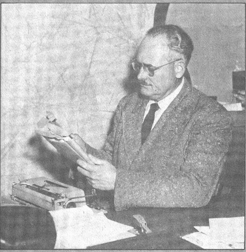
The Savage Father
She takes prides in the Pal-produced Doc Savage: The Man of Bronze because Dent “was sure Doc Savage would be made into a movie someday, and he was right.”  She “enjoyed seeing it on the screen,” – a courtesy screening or from out of her own pocket, she does not say.  (She also technically does not say she enjoyed the movie, but “enjoyed seeing it on the screen,” and it is hard to know if by not commenting further she was politely parsing her words, or simply happy to see her late husband honored in this way, or truly fond of the film.)  For sure though she “liked the issues of Doc Savage comic magazines that you sent me,” something that should probably have appeared as a blurb on future Marvel covers.  

The interview ends as it should, with Kraft’s proper and primly respectful thank you to The Woman Behind “The Man Behind Doc Savage” – the bronze gentleman adventurer himself could hardly have done better.  FIN.  


# # #


The Professor of Dust and Dinge, Gilbert Colon, will return on September 6th for in-depth coverage of the sixth issue of Doc Savage Magazine. You can also catch Gil's thoughts on Solomon Kane now and then in our regular post on Wednesdays!


Wednesday, July 22, 2015

July 1976 Part Two: The Ultimate Cross-Over? Marvel Two-In-One-Team-Up!

The Invaders 7
"The Blackout Murders of Baron Blood!"
Story by Roy Thomas
Art by Frank Robbins and Vince Colletta
Colors by Phil Rachelson
Letters by John Costanza
Cover by Jack Kirby, John Romita, and Frank Giacoia


The Invaders repel a Stuka raid, Cap using the “compressed jets of ionized water” with which Namor has armed his flagship, and then separate:  the misanthropic Subby seeks solace in the Thames, PFC Rogers hits “the G.I. spots” (?) with Bucky and Toro, and the Torch tries to walk off a pensive mood amid the blackout.  Hearing screams, he sees the girl he had just passed being attacked by a masked vampire; after driving off Baron Blood and summoning help for her injured companion, the Torch takes Jacqueline home, noting that he sometimes calls himself Jim Hammond.  Her father, Lord Falsworth, reveals that he had his own heroic career as Union Jack, recollected by the Torch as “the famous ‘masked spy-buster’ of World War One.”

Relating how he had served in Freedom’s Five with hooded American flier the Phantom Eagle, French swordsman the Crimson Cavalier, and fellow Britons Sir Steel and the Silver Squire, he is shocked to learn that Baron Blood, “the Germans’ greatest secret weapon in the closing days of the last war,” has returned and left his mark upon Jacqueline.  A flaming “V” summons the others, with Cap and the boys barely surviving a mid-air collision with Baron Blood, and Namor irate when he arrives soon after to see the damage to his flagship.  Meanwhile, the vampire doffs his mask, conceals his fangs with oversized teeth, dons a monacle, and joins the others at dinner as Lord Falsworth’s “nephew,” John, who’s simply “dying to meet the world-famous Invaders.” -Matthew Bradley


Matthew Bradley: Aside from the more militaristic Brain Drain/Master Man/U-Man gruppe, Roy’s single greatest contribution to the Invaders rogues’ gallery is probably Baron Blood (not to be confused, natch, with the eponymous Mario Bava film), a Frank Robbins special if ever there was one.  But that’s not all, since this issue also introduces the splendidly clad Union Jack, complete with obligatory Phantom Eagle mention; without giving anything away, members of the Falsworth family will feature prominently in this book for the remainder of its run, which will be monthly starting with #8.  Sprinkled on the top are such character tidbits as the Torch’s ruminations on humanity, the  revival of his Golden-Age alias, and Cap’s newfound empathy after enduring the Skull’s control.

Mark Barsotti: You'd have to do a whole lotta noodle-scratchin' to come up with a better name for a Nazi vampire than Baron Blood. Reminds me of Man-Bat, which is fine, given that the D.C. neck-driller was co-created by Frank Robbins (oddly enough as writer on Detective Comics; Neal Adams was the artist). Glad Frankie's back on pencils here, as the limner of loose limbs was always the perfect artist for the retro rah-rah of the Invaders. 

Roy serves up another Blitzkrieg blast that goes down as sweet and smooth as a cold bottle of Yoo-Hoo. Subby doesn't get much to do here, but blond hottie Jacqueline Falsworth has the android Torch hot under the collar. Her father was the original Union Jack back in the Great War, and it's both perfect and not at all a surprise when our blood-thirsty Baron is last panel revealed as Lord Falsworth's nephew! 

But a tip, BB: if you're gonna be an undercover Ratzi, best dispense with the monocle...


The Invincible Iron Man 88
"Fear Wears Two Faces!"
Story by Archie Goodwin
Art by George Tuska and Vince Colletta
Colors by Janice Cohen
Letters by Joe Rosen
Cover by Gil Kane and Frank Giacoia


 Iron Man flies onto the train aboard which Pepper is taking Happy to a special clinic near Chicago, having abruptly resigned from S.I. after his relapse, citing Hap’s safety.  En route east from Arizona, a trucker finds his friend’s rig wrecked, its cargo of hogs exsanguinated, and has his stolen by the Blood Brothers; meanwhile, Tony returns to S.I., where Abe Klein works late planning repairs to the plant’s electrical system, and Roxie rejects Michael’s plan to make him jealous.  Summoned to free an unseen presence—trapped under rubble in Chelsea and tended to by derelict Scrounger—the Brothers battle IM outside the Lincoln Tunnel as shady p.i. Harry Key heads for S.I., and crippling his armor, the aliens leave IM to drown beneath a dock… -Matthew Bradley

Matthew: Veteran Shellhead-scribe Goodwin’s return gig lasts for only three issues, presumably due to his imminent EIC duties, yet I don’t see how he could do better than launching this tetralogy with a rematch against the Blood Brothers, whom IM battled twice during the Thanos War.  How’s this for trivia:  per the MCDb, Les Frères de Sang are Roclites, the same species as Borgia, the Black Knight encountered by Warlock in Strange Tales #178.  By Tuskolletta’s standards, this artwork is pretty solid, but since it rarely excels, the book usually stands or falls on its writing, and in true new-broom fashion, Archie sends Happy off on a 20-issue sabbatical, introduces Harry, and puts Abe back on the board; I won’t dignify O’Brien’s wheel-spinning status with the term “subplot.”


Chris Blake: For many years, this was the oldest copy I owned of IM; yes, another flea-market find.  The references in Avengers to this mag must have been very few; I’m sure I didn’t know what to make of this business involving Pepper & Happy, followed by Mike and Roxie, since all these storylines had been a-brewin’ for many a year in these pages.  

As I re-read the issue, I noticed that there weren’t many moments in the art that rang bells, which tells me this was not an issue that I had methodically read when I first acquired it (unlike recent issues of FF that we’ve discussed in recent posts, which feature far superior visuals that have been cemented into my memory). The splash page, with IM swooping in above the train, and Mike bending the spoon in his fist (p 14) are the only two images that were immediately familiar.  The Bloods look a bit goofy most of the time; considering that they’re supposed to be space-vamps (that is, they’re vampires from space – I’m not saying they dress-up, or anything), they don’t appear to be particularly menacing, you know -?  


Jungle Action 22
The Black Panther in
"Death-Riders on the Horizon"
Story by Don McGregor
Art by Billy Graham, Rich Buckler, Bob McLeod, and Jim Mooney
Colors by Hugh Paley
Letters by Irving Watanabe
Cover by Rich Buckler and Frank Giacoia


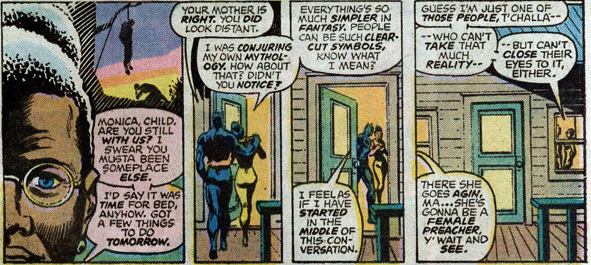
T’Challa and Monica gather with Monica’s parents on the porch.  Monica reflects on the nights in her childhood on this same porch, when she and Angela would sit and listen to their mother relate stories from their grandmother’s time, after the days of the Civil War.  Monica’s mother tells the story of Cousin Caleb, who is visited by hooded klansmen at his homestead.  He is ordered by them not to seek assistance from Loyal Leagues, or the Freedman’s Bureau, otherwise the death riders threaten to return.  From the start of the story, Monica finds herself drifting into its familiar rhythms, but now re-envisioning its details; this time, Caleb’s story plays out with a previously unseen protector, a Black Panther who leaps from the shadows to rout Caleb’s oppressors.  Monica continues to allow herself to imagine different outcomes, while her mother describes Caleb’s humiliation by white politicians, the threats by men masquerading as dead Confederate soldiers – one calling himself the Soul Strangler – and Caleb’s end, as he is shot and lynched by the Strangler’s mob; in each instance, by Monica’s fantasy, the Panther arrives in time to save Caleb.  In the final episode, Monica sees the Panther snared by a noose and hanged, except that the Panther is able to tear free, and drive the skeletal Strangler to the ground.  Monica admits to T’Challa that she has been “conjuring [ her ] own mythology,” since she sees herself as “one of those people … who can’t take that much reality – but can’t close their eyes to it, either.” -Chris Blake
Chris: This story serves as a bookend to this month’s Amazing Adventures, which also features a quiet evening spent recounting a story of past threat and violence.  The structures of both Caleb’s and Old Skull’s stories are similar, since both involve episodes of needlessly cruel treatment that the respective characters are forced to endure.  There is a stylistic difference, as Don allows the story to play out without editorial commentary in AA, but can’t help himself in this issue of JA from telling us about Monica’s reactions to Caleb’s story, and her need for a figure like T’Challa to intervene on Caleb’s behalf.  I’m struck by the thought that this story might have had a stunning effect if Don had allowed us to observe Monica’s imaginings, and provided insight to some of her thoughts, without having to resort to intrusive captions like: “If T’Challa had been present, he would have changed the course of events.”  Well yes, Don, we can see that in Rich’s illustrations.  Don’t get me wrong – the weight of Monica’s need for a different outcome still is powerful, but with AA #37 as an example, I’m saying that Don clearly could’ve allowed more space in this issue for the characters to tell the story themselves.  The other difference, of course, is that Old Skull’s story ends in a Martian-choreographed gladiatorial arena, while Caleb’s ends with the all-too-real, heartbreaking reality of his murder.  
I also want to take issue with the placement of this chapter in the “Angela’s Death” story.  Aren’t we still trying to determine whether other factors were involved: was she murdered?  If so, by whom?  Why are there no efforts toward the discovery of answers to some of these questions?  The relaxed atmosphere of the porch might be a better setting for an aftermath, much like the function of JA #18 following the conclusion of “Panther’s Rage.”  Don hasn’t inspired much interest so far in the search to resolve the questions involved with Angela’s death, and this issue only pushes those questions further away.


Chris: The letters page includes an usually long tribute to Billy Graham, as we’re told that he’s leaving behind the crazy world of comics to seek his fortunes on the stage.  Most of the time, when a title has a change of creative staff, we might have a line or two about it from ye editor, so this tells you how close this team had become over the past few years; nicely done, whether by Marv, or by a dutiful armadillo. Graham’s final work for this title can be seen on the first five pages, then Buckler picks up right where he’d left off months ago.  Not surprisingly, Buckler’s keen ability to mimic other styles allows for as seamless a transition as you could ask for, right down to Buckler copying the heavy, wavy lines Graham had used to frame Monica’s re-imaginings of Caleb’s story. 


Matthew: Sparing Professor Chris a visit to the Grand Comics Database to confirm it—although the line of demarcation is quite clear, even to me—the lettercol reveals “that [story] page 5 marks the end of the irreverent Billy Graham’s artwork for this [series] and that page 6 marks the return of Rich (Swash) Buckler, who started the long-line of stimulating graphics that have graced this magazine since Jungle Action #6.”  (They are respectively inked by McLeod and Mooney.)  “Graham has found less time to devote to comics these days, pursuing the sweet lure of the stage and the performing arts….Buckler and Don have worked on everything from the initial three [segments] of ‘Panther’s Rage!’ to Hodiah Twist’s appearance in Vampire Tales…”

We’re told that, “from merely a glimpse of the visual extravaganza [they] have brought forth for Jungle Action #23…the Panther is going to enter a whole new era of epic adventures,” but instead, we’ll get a reprint of his guest shot from Daredevil #69 (albeit with a cat’s-meow Byrne/Adkins cover), making this Don’s penultimate issue.  Jim is the tail wagging Rich’s dog, so it’s a shame they couldn’t have Bob ink the whole thing, while Monica interpolating T’Challa into her borrowed memories is an interesting but arguably failed experiment.  Devoting space to multiple versions of the same events seems to exacerbate the problems of a deadline-challenged 17-page bimonthly, and faces my standard prejudice against events that never “really happened.”


Master of Kung Fu 42
"Clock of Shattered Time"
Story by Doug Moench
Art by Paul Gulacy and Tom Sutton
Colors by Don Warfield
Letters by Denise Wohl and Irving Watanabe
Cover by Gil Kane and Al Milgrom


Shang-Chi meets with Sir Denis to discuss his recent reticence to participate in agency escapades.  S-C acknowledges that Black Jack Tarr was able to convince him that he should work to safeguard his friends and allies, and to pursue the clue that could reveal the mole who poses a threat to them all.  Toward the end of their discussion, S-C observes a ticking sound, which Smith passes off as his office clock.  S-C resolves not to swear allegiance blindly to Smith and walks out of Smith’s office; Smith (frustrated by S-C’s reticence) follows after.  At that moment, a time-bomb hidden under the desk explodes, and tears thru Sir Denis’s office; SD happens to be at a safe distance, and is largely unharmed.  S-C meets with Reston and Lambert, who inform S-C of a former MI6 operative named Lancaster Sneed, who had parts of his body re-built with metal plates after being badly injured on a mission.  Sneed was deemed mentally unfit to return to the service, so he modified the plates to form an “electrical exoskeleton” that could emit shock-waves; he took this new ability out to the carnival circuit, where he thrilled crowds with his destructive blows to concrete slabs.  Sneed, then calling himself “Shock-Wave,” took his talents to the Russians, and later tried to recruit Lambert after his dismissal from MI6.  Lambert believes that the lead to Oriental Expediters could result in S-C meeting Shock-Wave; Lambert and Reston, for reasons of their own, ask S-C not to discuss their knowledge of Shock-Wave with Smith.  Black Jack and S-C arrive at the Oriental Expediters warehouse and fight some hooded goons.  As predicted, Shock-Wave joins the fight, and beats S-C soundly; Black Jack chases him off, as Shock-Wave appears to leave the scene faster than Tarr’s gunshot.  Smith arrives, and reports that Leiko – on the hunt in Switzerland for clues to the mole’s identity – has been exposed, along with a counter-agent, and is in need of immediate help; barely able to reply, S-C sinks to the ground, overcome by pain and exhaustion.  Back at the MI6 office, Shock-Wave observes while a new bomb is being set, assured it will not fail – by Dr Petrie! -Chris Blake


Chris: MoKF has had its share of cliffhanger endings, but the series hasn’t been known for twists like this.  Could Petrie be the mole?  Well, in today’s crazy world, I guess anything’s possible.  Although, I will say that Petrie looks a little spooky in this final panel – could he have been hypnotized, somehow -?
 Gulacy provides the reader with some reality-testing, as from the first page of the story, he intercuts the discussions in various agency offices with scenes from S-C’s clash with Shock-Wave; in effect, the set-up to this battle, and the battle itself, are shown as somehow playing out simultaneously, despite the fact that S-C will not meet Shock-Wave until later.  It’s as ingenious as it sounds; best of all, there are no captions to clue us in to the proper sequence of events.  The reader is required to stay with it, until it becomes apparent that we’re following both story threads; in essence, the reader can decide whether the office events are “real time,” or whether the pre-fight discussion is being seen in a sort of flashback.  Nifty.
This approach achieves a few things: 1) we aren’t bogged-down in the exposition, as Gulacy continually distracts us with a view to the results of the discussion; 2) we see that the battle isn’t going well for our hero.  Especially in the later frames, S-C is rocked by bursts of electricity from SW; it’s a bit, uh, shocking, especially as we’ve become accustomed to seeing S-C maintain the upper (deadly) hand in many of his contests.  There’s every reason for S-C to approach this fight with his typical sangfroid and confidence; but we, in the audience, already know better, which makes us want to shout “Hey, Shang!  Don’t go into the warehouse, man!  Stay - Outta - the - Warehouse!”


I’ve never seen Sutton ink Gulacy before.  Gulacy & Adkins have set a very high standard, but a departure from  that look is welcome, especially when a different hand can introduce a variation without diminishing the effect we’ve come to expect.  I like the texture and darker look Sutton brings to some of the panels, such as the faces in Reston’s office (p 14, 15), and S-C writhing in agony (p 26, last pnl), with the broken head of the temple dog beside him.  The last panel on p 10 is pretty great-looking too.  
A final word, as I address the first image of the story: Gulacy’s now-familiar scene-setting splash page.  The dominant position of Shock-Wave, with Shang-Chi crumpled at his feet gives us a clear sense of foreboding for the battle to come (getting our anxieties going early! – “Wait,” we say, “what’s this -?”).  Beyond that, Gulacy adds some uncharacteristic Dali-esque effects, as we see floating clockfaces (timers for the bombs -?) and death-heads, with a cross-armed stone figure emerging from the ground.  In the distance, three figures – who appear to be Tarr, Reston, and Leiko – cast their eyes down from the fight, with flames behind them and a melting substance dripping from above, as they stand on an ornate coffin.  Surreal, man.


Mark: The movie poster splash page heralds Gulacy's return (his self-inking experiment was apparently too time consuming; Tom Sutton takes up the brush here, with no complaints). The mole hunt inside Sir Denis' covert-ops shop continues, even as Reston and Brando-double Larner telling Shang they can't share certain intel with Sir D casts unspoken suspicion upon the bald, bewhiskered spy-master himself.


Or maybe it's D's new hire, hot, blonde receptionist Miss Greville, who suspicious readers realize we've never seen before...


Mark: Leiko, on a suicide mission, is spoken of but unseen. S-C inadvertently saves Sir Denis from several sticks of dynamite, ACME brand apparently, since its concussive, killing range ends one step beyond an open office door.

The art is Steranko-graphic-swagger-meets-Adams-realism great once again. S-C faces another chop fooey foe, but Lancaster Sneed is also an up-powered Electro-wannabe, his high-voltage exoskeleton delivering burns with every blow. And if I was named Lancaster Sneed, I'd opt for Shock-Wave, too.

Shang's epic beatdown is played out in flashback throughout the book, milking a good thing, Gulacy's first spandexed and armored, Spidey-worthy villian. Only Black Jack's arrival with a real big handgun spares S-C the Deathblow (We can still get tickets, Jerry), and largely-forgotten Dr. Petrie revealed as the (perhaps hypnotized) bomb-toting mole is a tasty, puzzle-box surprise.


Master of Kung Fu Annual 1
"The Fortress of S'ahra Sham!"
Story by Doug Moench
Art by Keith Pollard, Duffy Vohland, and John Tartaglione
Colors by Petra Goldberg
Letters by Gaspar Saladino
Cover by Rich Buckler and Frank Giacoia


Daniel Rand presents himself at the London apartment of Shang-Chi; Sir Denis had suggested that S-C might be willing to help Danny locate Colleen Wing.  Since there is a life at stake, S-C agrees to help.  The two martial artists walk outside, and consider that they don’t know where to begin the search, when suddenly they are attacked by a group of warriors; neither Iron Fist nor S-C knows who might have sent them.  Once their last opponent is defeated, the brigade vanishes.  A new figure appears, identifying himself as Quan St’ar; he claims to be a magician from K’un-Lun, and states that an army from S’arha Sharn (an intra-dimensional twin city of K’un-Lun) threatens the golden walls of the city of harmony.  Iron Fist feels compelled to join Quan St’ar, even though he doesn’t completely trust him; S-C, seeing Danny about to face a threat to an entire city, feels obliged to assist.  Quan St’ar transports all three of them to S’arha Sharn, and directs them to a tavern where they expect to meet a contact who could help prevent the attack on K’un-Lun.  This proves to be a trap; a woman named Cybelle involves IF and S-C in a bar brawl, which results in IF and S-C arrested and condemned to a dungeon, while Cybelle is released by Quan St’ar.  Cybelle later reveals herself to be a leader of the local opposition; she explains how Quan St’ar intends to destroy K’un-Lun after having been banished for having slain a dragon that had threatened Yu-Ti.  Together, the two fighters join Cybelle’s forces and storm the castle.  IF and S-C locate Quan St’ar in his high tower, as he recharges his powers in the immense Globe of Eternity.  Danny powers up the iron fist and deflects mystic bolts from Quan St’ar, while S-C quietly reaches the globe.  He observes the leering, glowering evil within, before he shatters the glass; S-C leaps aside as the evil power pours out, and consumes Quan St’ar.  The uprising is successful, and Cybelle is appointed queen.  Danny and S-C decline her offer to remain immortals in S’arha Sharn, and are transported back to London, arriving in the city at the same moment they originally had left.  Danny elects to continue his search for Colleen alone, as he and S-C part as friends. -Chris Blake


Chris: Whew – as with the Giant-Size issues of not too long ago, I’m trying to be as concise as I can, but the synopsis still requires a lot of ink.  Doug packs in plenty of action, with two sustained fight scenes, and keeps the story going as the pages pile on.  Doug also does a nice job as he presents the perspectives of the two lead characters, just as they appear in their respective mags; you can distinguish the voices by S-C’s bits being in quotes, while Danny’s lines begin, as usual, with “You.”  I have to report, however, being distracted by Doug’s misfire on Danny’s dialog; not only does Danny talk too much, but he employs slang and other wisecrackery that doesn’t ring true for his character.  I imagine that Doug didn’t want an issue with two restrained rare-speakers, and wasn’t sure how else to distinguish between them, without resorting to playing-up Danny’s speech.
There are a few plot points that don’t make sense; the one that stands out is Cybelle’s statement that she opposes the attack on K’un-Lun because there needs to be a balance between good and evil (ie K’un-Lun opposed by S’arha Sharn), but once we’re at the end, it appears that Cybelle will establish a fairly benevolent, non-evil non-dictatorship in S’arha Sharn (I should mention that if you attempt to play “S’arha Sharn” in Scrabble, be prepared for me to challenge).  Cybelle’s reveal as savior to IF and S-C also is fairly predictable.  Although, these aren’t deal-breaker criticisms – overall, the issue is good fun.
Pollard’s art is the best we’ve seen from him for this title; there’s plenty of brisk action throughout, and a number of far-out panels as well (fittingly, for the inter-dimensional travel).  I especially enjoy the sequence on p 23 (above), as S-C and IF work together to foil a sword-bearing heavy.  Tartaglione and Vohland have very different styles, but there aren’t drastic shifts in the art’s appearance from page to page.   Last thing: whose idea do you suppose it was to present a Ditko-tribute, in the depiction of the magician at the end (p 46, pnl 3)?  


Marvel Feature 5
Red Sonja She-Devil with a Sword in 
“The Bear God Walks”
Story by Bruce Jones
Art and Letters by Frank Thorne
Colors by Don Warfield
Cover by Frank Thorne and John Romita

Red Sonja rides into a rain-soaked Zingarian hamlet to find the mayor holding aloft the body of a massacred young boy, the latest victim of the dreaded Bear God. The outraged politician proclaims that a reward for the forest beast has been posted, paid for by the townpeoples’ taxes. The red-hot Hyrkanian agrees to take the challenge — a handsome young minstrel named Tusan lasciviously agrees to come along. Before they head off to the forest, Red Sonja and Tusan fortify themselves with wine and food at a local tavern. Bedazzled by her beauty, a feeble-minded oaf named Bramus approaches the woman warrior: a brawl results and Sonja and Tusan slip out to begin their quest. Riding through the forest during a steady downpour, the two come across campsites of other bounty hunters, hungry for the reward. They bed down for the night in the minstrel’s tent, but a noise causes Tusan to investigate. When he doesn't return, Sonja heads off to find out what happened and is soon attacked by the huge forest bear — only a blast of lightning saves the woman as the bear is scared off. When Sonja regains her bearings, she discovers a tattered bear costume. Returning to Tusan's tent, she accuses the man of masquerading as the Bear God. But Bramus appears and douses their tent with oil: it appears that the brute was the one actually wearing the disguise, working with the mayor to claim the reward for themselves. Suddenly, the actual Bear God storms out of the woods and viciously attacks Bramus: the man drops his torch and both he and the bear are engulfed in flames. -Thomas Flynn


Tom Flynn: A decent little time killer, nothing very special. But Thorne provides his usually striking artwork. His bears — both real and fake — need a bit of fine-tuning though: while they do have the animal’s signature curved claws, they come across more like werewolves. Bruce Jones has been playing a little fast and loose with the whole “No man shall” vow, first in issue #2 with Dunkin and now here with Tusan: Sonja and the minstrel share a kiss before the man heads out to investigate the noise in the woods. This is Jones’ last issue by the way. Roy Thomas takes over next time and continues on until Marvel Feature wraps up with #7. The Rascally One will stay on board when our Hyrkanian hero’s true solo series, Red Sonja, debuts in January of 1977. Thankfully, Thorne will join him, at least until issue 11 — the Hyborian master John Buscema will see things out until that mag is cancelled after #15.


Marvel Two-In-One 17
The Thing and Spider-Man in
"This City -- Afire!"
Story by Bill Mantlo
Art by Sal Buscema, Mike Esposito, and Dave Hunt
Colors by Don Warfield
Letters by Gaspar Saladino and Jean Hipp
Cover by Ron Wilson and Joe Sinnott


Dr. Doom’s time-platform returns Spider-Man to the present just hours after he was summoned by the Scarlet Witch’s fireball, and vanishes as his memories of meeting Killraven and Deathlok fade; meanwhile, in the Savage Land, Ben knows that although Volcanus is dead, he did not cause the ominous eruptions.  Still seeking their source, he climbs down into the crater, discovering a cave wherein he battles the Basilisk and inadvertently teleports with him to New York.  There, Peter is alerted by a frantic phone call from Mary Jane to the presence of a volcano in the Hudson River, and arriving to find the Basilisk—whom he saw “killed” in Marvel Team-Up #17—holding aloft Ben’s apparent corpse, he vows revenge.  (Continued in MTU #47.) -Matthew Bradley


Matthew: As a kid, I was fascinated by the realization that the two halves of this crossover had been switched at the last minute: what is now MTIO #17 (whose credits even begin, “Brought to you by that finest of all possible team-ups”) opens with a direct continuation of chrononaut Spidey’s adventures from Marvel Team-Up #46, and the ostensible MTU #47 ends with “Next: The Scarecrow,” who was of course the guest-star in MTIO #18.  I may not have been aware of it at the time, but further internal evidence is provided by the fact that although Mantlo now writes both books, each half was drawn by the other’s regular artist, so we get the MTU Buscemosito workhorse here, and MTIO mainstay Wilson during his brief pairing with Adkins in the wind-up.

In fairness, they were cheerfully up-front about it.  MTIO #16 concludes, “Next:  No, we’re not leaving you up in the air like this—our story does have an ending—& you’ll find it in the pages of Marvel Team-Up #47 when the Thing meets up with the Amazing Spider-Man,” yet the lettercol in MTU #46 notes, “contrary to [that] bombastic blurb…[they] will be joining forces in just a few short weeks in the pages of Two-in-One #17.  (No need to get confused, folks!  It’s just that since the Thing’s book has gone monthly, your bedraggled Bullpen went in for a little juggling to keep things chronologically correct!)”  None of which, naturally, affects the story, and despite the decidedly disappointing MTU #6, a Spidey/Thing meetup is generally promising.

Part one faces an unusual challenge:  rather than starting from scratch, it must tie up the threads dangling from the prior issues of both books in addition to finding the customary rationale for the alliance, a structural problem that sadly reduces the opportunity for chemistry between our stars.  Actually, “eliminates” might be a better word, since they do not appear together on-panel until the last two pages, during which Spidey isn’t even sure Ben is alive, so this should perhaps have been called Marvel Set-Up.  Yet while it leaves a lot to be desired as a team-up, it’s a good yarn nevertheless, highlighted by Ben’s monologue inside the volcano, Peter’s struggling to deal with his time-traveling, the understanding black fireman, and that spectacular tableau on page 30 (below).


Marvel Team-Up 47
Spider-Man and The Thing in
"I Have to Fight the Basilisk!"
Story by Bill Mantlo
Art by Ron Wilson and Dan Adkins
Colors by Don Warfield
Letters by Irving Watanabe
Cover by Gil Kane and Joe Sinnott

Atop a volcano in the Hudson River (see Two-in-One #17), the Basilisk reveals that he was shielded from the lava by the Omega Stone—which encased him as it had Captain Marvel—and worshipped by the Subterraneans, one of whom unwittingly freed him, his life-force providing the power that triggered the volcanic chain-reaction.  Spidey revives Ben, stunned by the teleportation, but that round goes to the Basilisk, who humbles our heroes before flying off aboard a slab of rock to wreak destruction on New York.  However, after Spidey’s web conveys them to shore, they pummel and bat him toward the volcano; he passes out just as his eye-beams attain full strength and, unable to focus them, disappears as his power-bursts implode. 
-Matthew Bradley

Matthew: I always thought the Basilisk was cool, which in typical bass-ackward Bradley fashion enhanced my enjoyment of his debut in the Kree Jewels Case when I finally acquired #16-17 (especially the top half featuring my beloved Mar-Vell, diverted from a terrestrial front in the Thanos War).  Amid the general confusion surrounding this storyline, the second and third panels of page 2 are reversed, and it must be said that such a formidable foe is defeated far too suddenly, but overall the promise of part one is fulfilled with the enjoyable Spidey/Ben banter.  Bill seems to have brought out the best in Dapper Dan, who notches one of his better jobs over Ron’s pencils, and the two-pager of Spidey failing to dissuade Ben from delivering his classic battle cry is a delight.

Joe Tura: Prof. Matthew explained the history behind this crossover above, so I'll just stick to the basics here. Of course no Sal B. is a minus, especially since Wilson's pencils sometimes have odd angles that don't work so hot, and often his characters' hands are a bit too big and he draws Spidey too thick in places, but overall a decent issue thanks to some cool camaraderie between our two stars, a super-quick ending that's strangely welcome, and the silly coolness of the Basilisk. He's more ruthless than ever, especially killing one of the Mole Man's underlings who, by the way, are without a doubt the inspiration for the Minions from Despicable Me and their self-titled film your kids will make you see this summer!


Omega the Unknown 3
"Burn While You Learn!"
Story by Mary Skrenes and Steve Gerber
Art by Jim Mooney
Colors by Hugh Paley
Letters by Irving Watanabe
Cover by Gil Kane and Frank Giacoia

Still in the clutches of the evil fiend, Electro, Omega the Semi-Unknown must think fast if he's to survive the day. Electro wants Omega to rouse the metal man but won't say exactly what he wants him for. Meanwhile, James-Michael is having a hard time fitting in at the new school he's been enrolled in and, in fact, has a couple fights with a bully and is mistakenly smacked in the face by a teacher. No wonder the kid's all screwed up. Back at Electro's hideout, Omega has inadvertently reinvigorated the metal man, much to Electro's delight. The big plan finally comes into view when the shocking super-villain hijacks a TV charity telethon and steals all the donations (though one does wonder exactly how much cash would be on hand at a TV telethon!) with the aid of his new robot toy. Omega the Now-Quite-Well-Known arrives on set to bash the robot to little bits and zap Electro into submission. When pressed for a statement on the carnage, our hero offers up silence. Omega has saved the day but America wonders why he's so solemn. -Peter Enfantino


Yep...
Peter Enfantino: When the staff meets for lunch, there are several branches of discussion: "Who takes better dictation: Betty Brant or Lois Lane?"; "Where does Bruce Banner shop for clothes?"; "Did Stan write love letters to his wife or were those ghosted too?" but the mystery that's had the break room buzzing for the past few months has been: "Who the hell was Mary Skrenes?"

While there have been many, many ... interesting...  theories (the most popular being "Gerber was Skrenes"), I think I've solved the puzzle thanks to some of the writing exhibited in this issue's yawn yarn:

... said vulnerability is the metal man's predilection for frontal assault. The antibody melds its motion with that of its heavier, stronger opponent. Chill metal and warm dermis seem to fuse to move as one. But it's an organism at war with itself committed to the amputation of a supernumerary limb.

Wry vexation, bemused detachment, the stance of the unfeeling, unobtrusive observer... may no longer suffice if existence is to consist of more than sleepwalking...

Realities in collision -- the plane of nightmares, piercing, rather than meeting tangentially, the sphere of physical existence. 


Uh huh...
Yep, that's right. Mary Skrenes was...
Neil Peart.

It's all there, all the evidence was staring us right in the face the whole time. Just compare those immortal lines above to some of the stanzas Neil got paid quite a bit more for dreaming up a few years later...

Invisible airwaves crackle with life
Bright antennae bristle with the energy
Emotional feedback on timeless wavelength
Bearing a gift beyond price, almost free

Sprawling on the fringes of the city

In geometric order
An insulated border
In between the bright lights
And the far unlit unknown

No need to send me e-mails declaring my genius. I'll simply remind you that, as the Dean, it's my job.

Matthew (stepping in quickly after taking the Dean to the Nurse's office):  I can’t help noticing that of the four books Gerber is currently writing, the one I don’t much like (vs. his Defenders, HTD, and Guardians strips) is the one on which he routinely shares credit with muse Skrenes, but you may draw your own conclusions.  Not that it’s agony to read, or anything like that, and while Mooney’s art never jumps off the page, it’s not bad; it’s just that the book never grabbed me back then [insert standard buyer’s remorse] and, so far, isn’t grabbing me now, either.  That said, I found this the most enjoyable issue so far, and the reason is, ironically, Steve’s handling of Electro, who’s not a big favorite of mine, yet Omega’s “boring personality” allows Electro room for better development than so many villains receive...

Right


Luke Cage, Power Man 33
"Sticks and Stones Can Break Your Bones,
But Spears Can Kill You!"
Story by Don McGregor
Art by Frank Robbins and Vince Colletta
Colors by Janice Cohen
Letters by Karen Mantlo
Cover by Ron Wilson and John Romita

Luke Cage, Power Man is exiting a swanky restaurant with pals Claire Temple and Dr. Noah Burstein when a masked fiend calling himself "Spear" calls out Burstein and lets loose with a flying trident. The weapon misses the doctor but pins a terrified passerby to the wall. Cage pursues the nut into the city but Spear gets away.  Returning, Cage quizzes the good doctor as to why a sixth-tier super-villain would be hassling him. The doctor has no answer for Cage and the two part. When Burstein gets home, he's accosted once again by Spear, who leaves him a note explaining that very soon, the doctor will pay for his crimes. The next day, Luke Cage attends the funeral of little Auggie Simmons (murdered by Wildfire last issue -Paste Pot) and leaves wondering about the mental stability of the grieving family. -Peter Enfantino


We've checked with the MU's
Professor of Chiropractics and he assures us
this limberness will be costly
in Luke's later years.
Peter: It's been quite a while since I caught up on the freewheeling madness known as Power Man and I'm glad to see the book is as fun as it's always been. Hell, even Frank Robbins' rubbery shenanigans can't rain on this parade. Without trying to sound like a racist idiot, Don McGregor seems to be able to "get" these African-American characters, unlike the rest of his jive-scripting comrades in the Bullpen. Don gives us a bit of the Blaxploitation experience without rubbing our noses in it. There are no stereotypical black pimps wearing mink stoles and feathers in their hats (at least not in this issue) and, outside of one reference to Superfly, no goofball dialogue. The victimized passerby, when released from the choking grip of the trident, looks genuinely devastated and mutters "I...I.. couldn't... breathe..." repeatedly when asked by the soulless media what it was like to be attacked. But my favorite line is delivered by the Black Superman himself, after his first encounter with Spear (only the latest in a series of lunatic super-villains): "Why do I have to meet up with all the fruitcakes?" Let's not question our luck.


Skull the Slayer 6
"Swamp!"
Story by Bill Mantlo
Art by Sal Buscema and Steve Gan
Colors by Petra Goldberg
Letters by Karen Mantlo
Cover by John Buscema and Mike Esposito

Still attempting to find shelter and aid for the injured Dr. Corey, the trio of Scully, Ann, and Jeff head into a swamp, a locale that triggers disturbing memories for "the Slayer." Meanwhile, The Black Knight and Slitherogue have their final showdown, a battle that ends with the Knight victorious and a mortally wounded Slith pulling a lever that destroys the Knight, himself, and the Time Tower. The destruction is viewed far across the land by Team Scully but they avoid discussion, knowing therein lies madness. Back in "the real world," a Coast Guard cutter fishes Corporal Freddy Lancer out of the sea and the Captain listens as Freddy tells him the fantastic story of what happened to Scully and the rest of the occupants of the downed plane. Coincidentally, one of the men aboard happens to be Jeff's father, Senator Turner, a man who listens with great interest to Lancer's tale. Back in the prehistoric swamp, Team Scully is attacked by murderous Indians but the action is interrupted by the arrival of a giant Icthyosaur, who promptly gulps down several members of the warring party before "the Slayer" slices the beast to ribbons. The remaining Indians first fall to their knees and give thanks to their new God, then lead our heroes through the jungle to the fabled Lost City of Gold. -Peter Enfantino


Peter: What the heck was Senator Turner doing on that Coast Guard cutter, searching for his son fifteen hundred miles from where the plane had gone missing? Who knows? And, as with so many other bizarre and befuddling plot turns in this series, it matters not. This title, to me, seems to be made of Teflon. Perhaps it's because Marv, Steve, and "Angry Young Man"-tlo don't seem bound by an outline or even a goal; they're constantly writing themselves into a corner and somehow getting out of that corner in an entertaining way. Hell, "Angry" blows up the Time Tower this issue. Without that particular structure, how do our characters get back to "civilization" (at one point, Scully keenly observes that "a guy could kinda get to like all this pre-history stuff. Nothing to do but relax... and try not to wind up some hungry dinosaur's dinner")? How will the Senator and the vengeful Lancer (who still wants to grind Scully in the dirt without really having a reason) find that time rip in the Bermuda Triangle that marooned Team Scully? I sure hope Bill's got something up his sleeve in the last two issues!

Bill spills his guts on a special op-ed page, giving us the lowdown on his Marvel career, beginning with his big break on the "Sons of the Tiger" strip and leading to Marv Wolfman assigning him Skull. Mantlo goes on to explain he took the job only with the proviso that he could reset the entire series as he saw fit. Hence the eradication of Slitherogue and the Time Tower this issue and the return to the Burroughs-ian concept of a lost world filled with meat-eating dinosaurs in the next. As someone who was highly critical of Mantlo's early "Sons of the Tiger" stories, let me say that he has lived up to his wish of taking over Skull and proving himself "competent on more than just the level of a "fill-in writer.." (Bill's words). Based on what my colleagues write about the author's stints on other titles and the evidence staring me in the face with Skull and "The White Tiger" (from Deadly Hands), Mantlo could just be the guy who slides into the throne soon to be abandoned by Stainless. Bold words, I know.


Matthew:  I have no recollection of why I bought this lone issue, and even less idea what I would’ve made of it back in the day with, per The Big Lebowski, “no frame of reference.”  I know from our august Dean’s entertaining coverage that a lot has happened in this mag’s brief lifespan since #1 (which I only recently read courtesy of Marvel Firsts), and find it hilarious that incoming writer Mantlo re-reset Englehart’s one-issue reset, as he details in his lettercol essay.  Not surprisingly, in trying to chart his new course, Bill has made this rather exposition-heavy; Buscema’s art is customarily attractive, although Gan—who was the sole artist on the first three issues and returned to ink this one—certainly makes his presence felt.  Skull, seeya in MTIO #35.


The Mighty Thor 249
"The Throne and the Fury!"
Story by Len Wein
Art by John Buscema and Tony DeZuniga
Colors by Glynis Wein
Letters by Gaspar Saladino, Joe Rosen, and Marcos Pelayo
Cover by Jack Kirby and Joe Sinnott

When he seeks audience with his father, Thor is not only unwanted but actively driven away. He and the others who agree Odin has really lost it decide they need help--and set forth to ask it of Karnilla the Norn Queen. Meanwhile, Odin  has the Odinsword moved into the throne room and the throne likewise right beside it. Thor, Balder, Vizier and Sif (her spirit uniting with Jane's apparently allows a switcheroo) find a bitter and reluctant Karnilla, who eventually agrees to help. Upon their return to Asgard Karnilla's power combined with Thor's breach enough of an opening in the force barrier set up around the castle for Thor to enter.  Odin allows this, long enough for the truth to be seen. Odin is mad because he is Mangog! So where has the real father gone? -Jim Barwise


Jim Barwise: Len Wein keeps us nicely in suspense till the last;  I know I didn't suspect the Mangog reveal first time I read this tale. If I recall my 60s reviews,  no less than Dean Peter plugged Mangog's initial saga as the best of all the decade's titles, so this can't be bad. We've got some classy characters together (Karnilla another, so far, ignored in the feature films) to join the battle. I personally like the Jane /Sif alternates; poor Thor, such problems he has! I find Wein's plots have a slightly more credible, clever buildup than Gerry Conway's epic madness, though I love them both. Well, with a billion billion bad guys in the building,  there's no turning back!


Matthew: I think Professor Flynn is a big DeZuniga fan, but I find his embellishment here distressingly heavy at times, almost Jansonesque in marring my enjoyment of a Buscema brother’s work.  Otherwise, though, this one’s a winner:  throwing the Odinsword, Karnilla, and Mangog into the mix makes a great set-up for #250, and Len not only reveals the reason for Odin’s supposed madness but also takes the long-simmering Jane/Sif subplot he inherited from Gerry to its logical next step (unerringly pegged by lettercol correspondent William Allen in this very issue).  This month’s Wolfman Wackiness bills EIC Marv as Face in the Crowd, Lab Technician, and Back-Seat Barbarian in the current Thor, Spidey, and Hulk entries, respectively.


Chris: Let’s direct our attention to pages 16-17, as there are several interrelated story elements to enjoy here.  First, Len reminds us that each of the three travelers is lost in his own thoughts, as Thor weighs his feelings for Jane and (recently reappeared) Sif, Balder sifts thru his conflicted emotions regarding Karnilla, while the Vizier (dutifully) considers the uncertain nature of the state.  Buscema makes effective use of perspective, as his presentation of lounging Karnilla obscures the approaching figures of Thor and Balder, both of whom seem tiny by comparison – gives you an idea of their misgivings as they approach her, right?  Their concerns are well founded, though, as Karnilla rebuffs the seemingly reasonable requests by Thor and Balder for her aid against Odin’s “mystic barricade.”  It requires the Vizier’s argument, that her desire for “the hollow taste of vengeance” against the Asgardians could result in conflagration that could consume not only Asgard, but Karnilla’s realm as well, that finally engenders her reversal.  


I know that de Zuniga is a capable artist, but I’m not crazy about his finishes on Buscema’s pencils for this title.  The overall effect is inconsistent, as on the same page, I see panels that are dynamic and atmospheric, paired with others that come off looking unfinished, or too grainy.  If more of the art looked like page 3-last pnl (Thor smashing some guards), and page 11-last pnl (an imposing look from Odin – well, we think it’s Odin), then I’d be perfectly happy with it.


The Tomb of Dracula 46
"Let Us Be Wed in Unholy Matrimony"
Story by Marv Wolfman
Art by Gene Colan and Tom Palmer
Colors by Tom Palmer
Letters by John Costanza
Cover by Gene Colan and Tom Palmer

Dracula weds the strange, exotic Domini in front of his new subjects, the Satanic cult led by Anton Lupeski. The ceremony goes well and Drac wings his new bride off to their honeymoon pad. Meanwhile, across town, at the offices of American Chemron, Windom faces Wally Slammerkin with the news that he's going to spill the beans to the government about the wicked, wicked ways the company has been dumping toxic sludge. Slammerkin's having none of this and blows Windom away. With the help of Chemron's board of directors, Wally dumps Windom's corpse into the spillway, knowing the acids in the chemicals will eat away at the body. Unfortunately for the conspirators, the chemicals only erode Windom's features and, somehow, resurrect his corpse. The shiny blank-faced creature rises from the river to seek out his killers. Dracula picks this time to go out for a bite to eat and happens to zero in on one of Windom's prospective victims, following her home. The Windom-thing caries on his carnage, taking a souvenir from each of his victims: an eye from one, a nose from another... He catches up with the woman just as Drac is about to do his deed and the two monsters battle. In the end, Windom gets his victim.. and his ears... and a mouth... and Dracula is robbed of a meal.
-Peter Enfantino


Peter: An interesting one-off but one that has a very distinct Swamp Thing vibe to it, both in the Windom-Creature character and the confrontation between Drac and the monster. I know it's silly, in a funny book about vampires, to go on about preposterous events but I must say that laughs, rather than chills, were elicited from this horror comic veteran by the murder spree of Mr. Potato Head. How in the world was Windom/Thingie able to "steal" his victim's features and add them to his face? Much like Luke Cage, Power Man For Hire, Dracula meets the strangest characters in his line of work. And, even by 1976, the "evil corporation heads" was a cliche. But then there's Gene Colan and Tom Palmer. Does it get any better? Gentleman Gene can, on the same page, make you loathe Dracula and lust after his new bride.

Chris: The faceless one, a product of pollution run rampant, could’ve easily been little more than a standard 70’s polemic (Hey, wake up, people!  We’re killing our Mother Earth, man, with our Styrofoam boxes and pop-tops!).  Fortunately, Marv starts with this idea, then does something especially nasty with it.  Best of all, he concludes the idea well, as the patchwork-faced undead creature wails about the emptiness and futility of vengeance, while Drac (missing the point completely) remains preoccupied by his need for payback – after all, this creature had denied him a kill Drac felt was rightfully his.


We have five panels – five – of an update on the Hannibal King/Blade project, so hopefully next ish Marv will feel ready to spring this story from its leash and let it run.  Also next ish, we could learn more about Drac’s attraction to Domini; Marv gives us a hint, as Drac nearly says “Maria” (p 14), but there could be more to it than that, right -?

Mark: Parts of this are a ghoulish gas. The Count letting a Satanic cult think he's the Big S (even though, last ish, he dramatically declared, "So swears Dracula!" But certain religious types always see their preferred deity on moldy Wonder Bread, eh?) is a great plot device that not only advances his unknown agenda, but also nets Drac new bride, Domini, who unexpectedly makes his black heart go pitter-pat.


And after-dark types have to love the occult odd couple, Blade and Hannibal King: can a vampire slayer and vampire detective team-up to hunt down a hated fanger without driving each other crazy? Alas, this intriguing sub-plot gets less than a page here.


Mark: Which leaves us with "the faceless fiend!" It's always dicey raising issues of credibility in a series about a five hundred year old bloodsucker (or comics in general), but Marv's cautionary pollution fable is a heavy-handed howler. Sure, I can buy the greedy upper management of Chemron offing the sheepish whistleblower in their wolf's den, then dumping his body in their noxious soup, which re-animates the now-vengeful corpse, but naming the greedy CEO Slammerkin is gilding the DDT-dead lily. At least Marv restrained himself from calling our oily tycoon "Earl Slick". 

As for Wolfman's faux-poetic prose regarding the murdered Windom's face being erased, what does, "Yes, the skin is now smooth as pearl...and the pearl, born within a life, is lifeless unto itself" even supposed to mean? While Windom's eye-for-an-eye - and other facial features - retribution is appropriately ghoulish, it's also a nonsensical conceit. 

Yeah, the final two page battle, with Windom depriving Drac of a late-night snack before dissolving into a puddle of goo, helps one swallow the over-cooked ham, but I'm still tempted to call the EPA. 


Werewolf by Night 39
"Some Are Born to the Night"
Story by Doug Moench
Art by Don Perlin 
Colors by Don Warfield
Letters by Debra James
Cover by Rich Buckler and Keith Pollard

Jack gets back to his stepfather's place to find Buck, Lissa and Topaz visited by Coker and Brother Voodoo, and everyone trades stories about The Three Who Are All, until a horde of zuvembies strike! Coker is carried off as the others fight off the undead. When night arrives, Jack begins to change, which is halted by the spirit of BV's brother, Daniel Drumm and Jack's strong will. Jack, Topaz and BV take off for Haiti's Devil's Grotto, which is also where renegade Lt. Northrup is headed after a tip. Not long after they land and walk through the jungle, the zuvembies attack! Jack changes into the Werewolf, which of course helps the trio win again, but it seems as Jack has remained in control. When they make their way into the heart of a cavern, Coker is found bound and hanging from the ceiling, changed into a werewolf and the captive of Dr. Glitternight!--Joe Tura


Joe: A pretty darn good issue that gives us a shocker at the end, and one I hated. Mostly because I never liked that Glitternight dude. Not sure how or why he's back, other than he's a tough old nasty. Coker getting changed back is interesting, and they leave his glasses on, too! Although doesn't he look like a tailless Nightcrawler in that final panel? Or a skinnier Beast? Brother Voodoo gets plenty to do, but using the brother sprit trick twice in one issue is slightly lame. The usual creative team gives us their usual standards, with the twist of Jack finally getting some control over the savage beast. And of course, "Weremail By Night" features another Fred G. Hembeck letter, because, well, why not.


Chris: I’ve been enjoying the trend of significant improvement for this title.  The runs dries up this time, though, as the creepy atmosphere and surprising, unpredictable developments that had characterized recent issues are conspicuously absent this time.  Instead, we get little more than non-stop zombie-scrapping.  I’m glad that Jack is able (somehow) to control the Werewolf – maybe some vestige of Daniel’s loa is contributing to this effect, but who could say; as significant as that is, this is one of only a few surprising developments in the entire story.  One other moment is the nice twist as Coker (remember him?) is converted back to lupine form (“But wait guys, I’ve been cured!” he insists), but the return of Glitternight is unwelcome.  What’s next, Round 3 against the Hangman?  Paste-Pot Pete, perhaps?  Well, I’m willing to be patient until the next issue.


Also This Month 

Chamber of Chills #23

Crazy #18
Kid Colt Outlaw #208
Marvel's Greatest Comics #64
Marvel Classics Comics #7
Marvel Super-Heroes #58
Marvel Tales #69
Marvel Triple Action #30
Rawhide Kid #134
Ringo Kid #28
Sgt Fury #134 >
Spidey Super Stories #17
Tomb of Darkness #21


THOSE MARVEL-OUS MAGAZINES!


Planet of the Apes 22
Cover by Earl Norem

"Quest for the Planet of the Apes"

Part 1: Seeds of Future Deaths
Part 2: Keepers of Future Deaths
Story by Doug Moench
Art by Rico Rival

We interrupt our regular Terror saga and Apes movie adaptations to bring you a special two-part Quest for the Planet of the Apes, an "interim saga, bridging the events chronicled in the 20th-Century Fox movies Conquest of the Planet of the Apes and Battle for the Planet of the Apes!, per the splash page.

Part 1: "Seeds of Future Death" begins two years after the end of Conquest, with a new city near completion, built by human servants to the apes. Caesar is speaking with wife Lisa when gorilla Aldo threatens a human, and the leader jumps to his defense, catching flak from captive Breck, diplomacy from MacDonald, and disdain from Aldo. That night, Caesar luckily is unable to sleep when a firebomb is thrown through his window. Aldo blames the humans, but Caesar accuses Aldo himself, which leads to a challenge for ruler of the apes, to be held in the "old city of humans". However, as MacDonald warns, the city has been destroyed by an atomic bomb! Lisa announces she's pregnant, Breck plots revolt, and Caesar is shocked to see the ruins of the city, just as Aldo discovers the human armory. He shoots at Caesar, wounding the horse his leader steals, then begins stockpiling guns. Breck and the other humans knock MacDonald out, kill a guard and escape the camp. Just after dawn, Caesar returns warning of the "forbidden zone of horror" but Aldo returns before he can finish speaking…and MacDonald stumbles in, hurt and warning about…Breck, who grabs Lisa and some guns!


Before we get to the second half, we are treated to a longer "We Heard It Through The Ape Vine" featuring a letter by none other than Ralph Macchio, who goes on and on about Future History Chronicles, as well as other much lesser-known fans. Next up is Jim Whitmore's "Thirteen Decades of the Ape" article, which is quite skippable. Then "From Shakespeare to Simian" by Robert Cleveland, a fawning look at Maurice Evans, portrayer of Doctor Zaius. I will admit I just deleted the word "Sir" before Evans' name, mistakenly assuming he was knighted. Seemed like that would have made sense because nearly every famous Shakespearean actor gets knighted.. But hey, nobody's perfect.


On to Part II: "The Keeper of Future Death!", the "searing conclusion" of our two-part saga. An older orangutan sneaks behind Brent and takes him out, freeing Lisa from his clutches, but this sets off the humans firing on the apes. Aldo hesitates, but decides to join Caesar in the fray, with the apes quickly gaining the upper paw. An unnamed human fires at Caesar's back, but the orangutan, named Mandemus, jumps in the way and is wounded. The beaten humans flee, with Caesar chasing after Breck, but choosing not to kill him, but only to banish him back to the dead city, with the former Governor vowing to return. Back at the city, Aldo challenges Caesar again, with the terms being if Caesar wins, humans and apes will live together peacefully and Aldo's "precious guns must be destroyed". With Lisa and MacDonald against the challenge, Caesar goes through with it the next morning, using superior intelligence, agility and a bit of trickery to defeat the enraged Aldo by trapping him hanging by his foot from a tree. Keeping the guns under lock in key just in case, Caesar is named the leader of the "new integrated society", and he and wife Lisa decide to name their boy Cornelius when he's born, after Caesar's father, with Aldo watching on, already hating the name.


A nice job by Doug Moench here, expertly presenting a bridge between the 4th and 5th movie adaptations, aided and abetted by two excellent artists. Rico Rival takes Part I, a wordy chapter lending itself nicely to his clear pencils and expressive closeups. And the page where we first see the ruined city is shocking and horrible. Part II give us the fine work of Alfredo Alcala, capturing the growing anger of both human and ape, and bringing us bone-crunching action. This two-parter overall is a must-read for any Apes fan, both the comic mag and the movies. But there's one thing that bothers the heck out of me: why is MacDonald the only human without a beard? Was he the only one allowed to shave since Caesar liked him the most? –Joe Tura


The Deadly Hands of Kung Fu 26
Cover by Malcolm McNeill

"White Tiger"

Story by Bill Mantlo
Art by Jim Sherman and The Tribe

"Swordquest Part Two:

Dragon Delta"
Story by John Warner
Art by Tony DeZuniga

The ninja assassin assigned to terminate Jack of Hearts holds White Tiger's sister, Awilda, hostage but Jack wakes form his coma long enough to blast the thug out his hospital window and to his death. Meanwhile, in Africa, Abe Brown faces down the hijacker known as The Mole across a pit filled with poisonous snakes. The Mole, with the advantage, fires at Abe but Abe, using his Kung Fu skills, catches the bullet in his hands. Taken aback, The Mole makes a very fatal error and falls into the snake pit. Abe is handed the briefcase holding the superhero uniform and asked by the tribe to don it. Lin Sun waits at the telegraph office for word on Bob Diamond but when it comes, the news is all bad. Somwhere in Canada, Bob Diamond pulls himself out from under the avalanche and collapses, exhausted. Will he freeze to death?


Santa Madre de Dios. ¿realmente tenemos que leer estas cosas?
It's one step up and two steps back for the "White Tiger" series this issue. Not only is all the back and forth confusing (stories mingle together from panel to panel) but the art, by fill-in James Sherman, is awful, with several of the characters' facial features interchangeable. As far as I can tell, this is the only piece by Sherman we'll be subjected to during our tenure at MU. That's the good news. The bad is that "Angry Young Man"-tlo's ascendence to greatness is stalled, if for only one issue (I hope). All the intricacies of the various plot threads that Bill had carefully maintained and nurtured throughout the last several issues are seemingly cast aside as if the writer can't be bothered with these story lines any more and just wants to start anew. Tired of the ninja assassin? All right, we'll toss him out the window. The Mole grating on you? Okay, we'll have him do his best Chevy Chase impersonation and fall into the snake pit.  The only subplot left to fascinate is Bob Diamond's emergence from an avalanche burial. I'll stick around for that one. And we also get the annoying return of the Hispanic-with-English-translation word balloons. Oh man, I hate that! One or the other, Bill, but not both!


Did you think I was kidding you about this scene?
The Deadly Breasts of Kung Fu #DD:
"Open Up and Say Ahhh!"
Kwang-Che Yu's assignment is to travel to the Dragon Delta and prevent the assassination of Yi Sunsin, a genius who has designed a battleship made of metal called the Kobukson (Turtle Ship). Once there, Kwang-Che Yu finds that keeping Yi Sunsin alive will be a difficult task as it seems the entire countryside is sending their best ninja warriors to do the job. Eventually, the great Kobukson is put to the test.

While the art, compliments of Tony DeZuniga, has definitely gotten better, the script for Chapter Two of the Swordquest "epic" is still incredibly boring, layered with oodles and oodles of uninteresting historical facts and characters. Kwang-Che Yu suddenly comes off as a member of Impossible Mission Force (and his "boss man" tells him: "Your mission, simply stated, is to prevent either circumstance from occurring at all costs!"). Writer (and title editor) John Warner throws in a bared breast and an exclaimed "Bitch!" just to remind us that this series is adult-themed. I'll take spandex and cowls over this any day. -Peter Enfantino


Using the adult medium of B&W magazines to its fullest